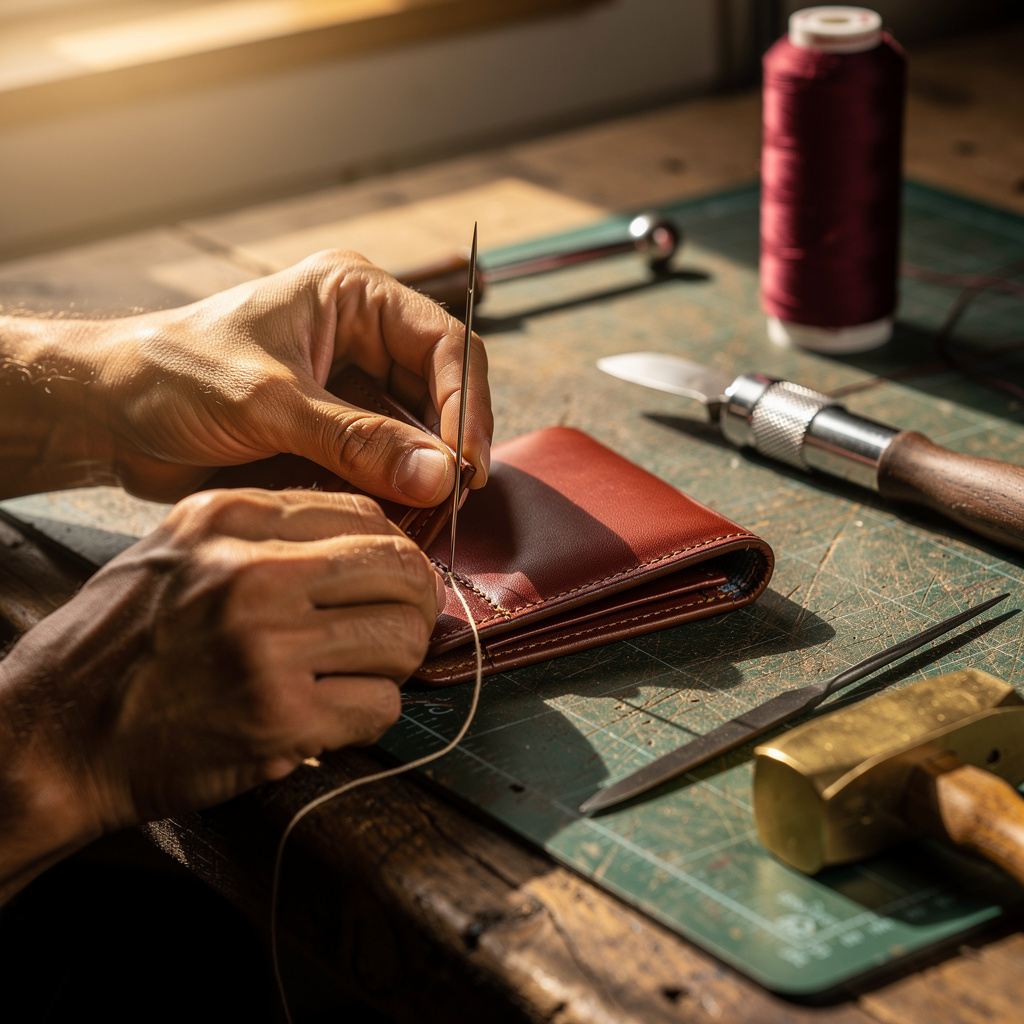
What is Leathercraft Basics?
Leathercraft Basics Training Program
The Leathercraft Basics certificate program is a hands-on, project-driven course that teaches you how to transform raw leather into finished goods using traditional hand tools and techniques. Designed for absolute beginners and hobbyists alike, the program covers everything from selecting the right leather and setting up your workspace to cutting, stitching, and finishing. By the end, you will have created a functional key fob or coaster, a simple wallet or belt, and gained the confidence to tackle your own designs.
The program is structured as a beginner-friendly journey, starting with leather properties and essential tool safety, then progressing through cutting, stitching, edge finishing, and hardware installation. Each lesson balances theory with practical exercises, building four core skill areas: material knowledge, tool proficiency, hand-stitching technique, and project planning. With the growing interest in handmade goods and sustainable craftsmanship, this is the perfect time to learn a timeless skill that combines creativity with utility.
What is Leathercraft Basics?
Leathercraft Basics is the foundational practice of working with leather to create durable, functional, and often decorative items by hand. It encompasses understanding the different types of leather—such as full-grain, top-grain, and veg-tan—and their unique properties like thickness, flexibility, and dye absorption. Core concepts include cutting patterns, skiving edges, saddle stitching, edge burnishing, and setting rivets or snaps, all of which rely on simple hand tools rather than heavy machinery.
Today, leathercraft is experiencing a renaissance as people seek alternatives to mass-produced goods and embrace slow, mindful making. It is used in small-batch production of wallets, belts, bags, and accessories, as well as in restoration work and bespoke commissions. Recent shifts toward sustainability and personalization have made hand-stitched leather items highly valued, both as gifts and as marketable products in artisan communities and online marketplaces.
Mastering leathercraft builds a versatile skill stack that includes fine motor control, spatial reasoning, material science, and design thinking. These competencies are directly applicable to careers in fashion, product design, and small business ownership, as well as to personal projects like crafting heirloom-quality gifts or repairing beloved leather goods. The discipline also fosters patience and attention to detail, qualities that benefit any creative or professional pursuit.
Common Questions About Leathercraft Basics
Is Leathercraft Basics for absolute beginners?
What does the Leathercraft Basics certificate prove?
Why is full-grain leather the best for projects?
- Durability: The intact grain layer resists wear and tear better than any other leather type.
- Patina: It ages gracefully, gaining character with use.
- Breathability: Natural fibers allow moisture to escape, preventing damage.
How do I perform a saddle stitch correctly?
- Thread both needles: Pass the thread through each needle's eye and pull until equal lengths.
- Mark your stitch line: Use a stitching wheel or groover to create a consistent guide.
- Start stitching: Push one needle through the first hole from the front, then the other needle from the back through the same hole.
- Pull tight: Tug both ends evenly to seat the stitch firmly.
- Repeat: Continue alternating needles through each hole, maintaining even tension.
What is the most common mistake in edge finishing?
How to choose the right cutting tool for leather?
- Leather thickness: Thicker leather (8-10 oz) requires a heavier knife or a head knife.
- Cut type: Straight cuts need a ruler and utility knife; curves need a swivel knife.
- Grain direction: Always cut with the grain for strength, as covered in the 'Cutting Leather' unit.
Is hand stitching weaker than machine stitching?
What Will This Course Bring You?
- Analyze the characteristics of full-grain, top-grain, and bonded leather to select the best material for a project.
- Set up a functional leathercraft workspace by identifying and organizing essential tools and materials.
- Apply precise cutting techniques using a rotary cutter and straightedge to achieve clean, accurate leather shapes.
- Prepare leather edges by skiving, beveling, and grooving to ensure proper alignment for hand stitching.
- Execute a saddle stitch with consistent tension and spacing to create durable, professional seams.
- Apply edge finishing techniques including sanding, burnishing, and dyeing to achieve a polished, smooth edge.
- Install common hardware such as snaps, rivets, and buckles using appropriate tools and techniques.
- Design a simple pattern for a leather project by drafting and transferring measurements onto card stock.
Curriculum
12 Units1. Understanding Leather and Its Properties
1 hour
2. Essential Tools and Workspace Setup
1 hour
3. Cutting Leather
1 hour
4. Preparing Leather for Stitching
1 hour
5. Hand Stitching Fundamentals
1 hour
6. Edge Finishing Basics
1 hour
7. Hardware Installation
1 hour
8. Simple Project: Key Fob or Coaster
1 hour
9. Pattern Making and Design
1 hour
10. Intermediate Project: Card Wallet or Simple Belt
1 hour
11. Leather Care and Maintenance
1 hour
12. Troubleshooting and Next Steps
1 hour
Exam – Leathercraft Basics
20 Questions • 70% Pass • 30 min
Unlock All Units for Free
Create an account, enroll in the course, and start with the first unit right away.
Exam – Leathercraft Basics
20 Questions • Pass: 70% • 30 min
Course Duration
720
Total Minutes
12
Unit
1
Final Exam
~60
Min / Unit
Leathercraft Basics Certificate Program
Document Your Skill
Those who pass the 20-question, 30-minute exam with 70% receive the Leathercraft Basics Certificate.
Stand Out on Your CV
By adding your certificate to your CV, gain a professional reference in job applications and stand out from the crowd.
Career Advantage
With the verification code, employers can check your certificate instantly — a concrete way to show your growth.
CERTIFICATE FEE
At the end of the course, an online exam consisting of 20 questions with a 30-minute time limit is given. The exam appears automatically after you complete the topics. Anyone who scores at least 70 out of 100 on the certificate exam is awarded the Leathercraft Basics Document (certificate of attendance). You can add the certificate you earn to your CV for job applications in the many sectors listed above, and use it as a reference proving that you took this interactive course.
The Certificate of Achievement you receive with the Leathercraft Basics course program holds value that proves your personal and professional development in the business world. By adding it to your CV, it can serve as an important reference in your job applications. Moreover, compared with certificates from other private training institutions, Catch Wisdom certificates are offered to our participants at a much more affordable price.
The Leathercraft Basics course certificate is a document that proves, with a unique verification code, that you completed the course. Employers can instantly check its authenticity with this code, which helps you show your development concretely in your job applications.
For more information, we recommend visiting the Support page.
Certificate in 7 Languages
Earning success certificates from our courses is now more meaningful and global. With certificates available in Turkish, English, German, French, Spanish, Arabic, and Russian, we fully unlock the potential of students worldwide.
Why Certificate in 7 Languages?
-
01
Global Skill Development
Receiving your certificates in 7 different languages strengthens your communication skills as you engage with more people worldwide. It lets you operate more confidently and capably on the international stage.
-
02
International Job Opportunities
Employers may see your certificates in multiple languages as a sign of your ability to seize global opportunities. You can open more doors to new jobs and projects.
-
03
Cultural Richness
The chance to earn certificates in different languages helps you build closer ties with various cultures and broadens your worldview. It enriches your global perspective and deepens cultural understanding.
-
04
Ability to Participate in International Projects
Multilingual certificates give you an edge to work more effectively on international projects. They boost your chances of leadership and participation in diverse projects in the business world.
-
05
Prove Yourself on the Global Stage
Certificates in multiple languages give you the opportunity to present your skills and knowledge worldwide.
Language diversity opens worldwide opportunities. If you want to prove yourself in the international arena, join our online Leathercraft Basics course program and begin this journey with us.
Frequently Asked Questions (FAQ)
Is this course paid?
How do I join the course?
Can I take the course at my own pace?
How can I get my certificate?
What are the advantages of the certificate?
Boost Your Career
Take a new career step with the Leathercraft Basics course. Add your certificate to your CV, stand out in job applications, and open the door to new opportunities in the industry.
StartStudent Reviews
No reviews yet
Enroll in this course and be the first to leave a review about your experience with Leathercraft Basics.
Start