What is Mid-Century Modern Design?
Mid-Century Modern Design Certificate Program
Mid-Century Modern Design certificate program examines the mid-twentieth-century movement across architecture, furniture, industrial and product design, graphics, textiles, interiors, and lighting, using its origins, defining principles, regional variations, and material innovations as organizing threads. It is designed for designers, architects, interior professionals, collectors, curators, historians, and serious enthusiasts who want to move beyond surface style and understand how mid-century objects, spaces, and visual identities were conceived, produced, and disseminated. Through the lessons on residential and commercial architecture, furniture icons, appliances and electronics, graphic identity, and surface pattern, learners develop the vocabulary to describe form, material, and function with precision. The main practical outcome is the ability to contextualize, evaluate, and discuss mid-century modern design with historical accuracy and critical judgment, whether for design practice, collecting, research, or informed appreciation.
The program is structured as a beginner-friendly progression, beginning with foundations and historical context before moving into aesthetic principles, architectural expressions, furniture, industrial and product design, graphics, textiles, regional perspectives, materials and manufacturing, interiors and lighting, and finally decline, revival, and collecting. Theory is balanced with applied looking and analysis: learners compare American, Scandinavian, and Italian variations, trace how manufacturing innovations shaped form, and connect interiors and lighting to the mid-century lifestyle rather than treating objects in isolation. Across the lessons, the program builds five core skill areas: historical and contextual analysis; formal and aesthetic reading; typological and material fluency; regional and cultural comparison; and evaluation, preservation, and collecting judgment. Someone would choose this program now because mid-century modern design continues to shape contemporary interiors, product launches, branding, museum programming, and the resale market, while debates about authenticity, restoration, and sustainable reuse make informed expertise more valuable than ever.
What is Mid-Century Modern Design?
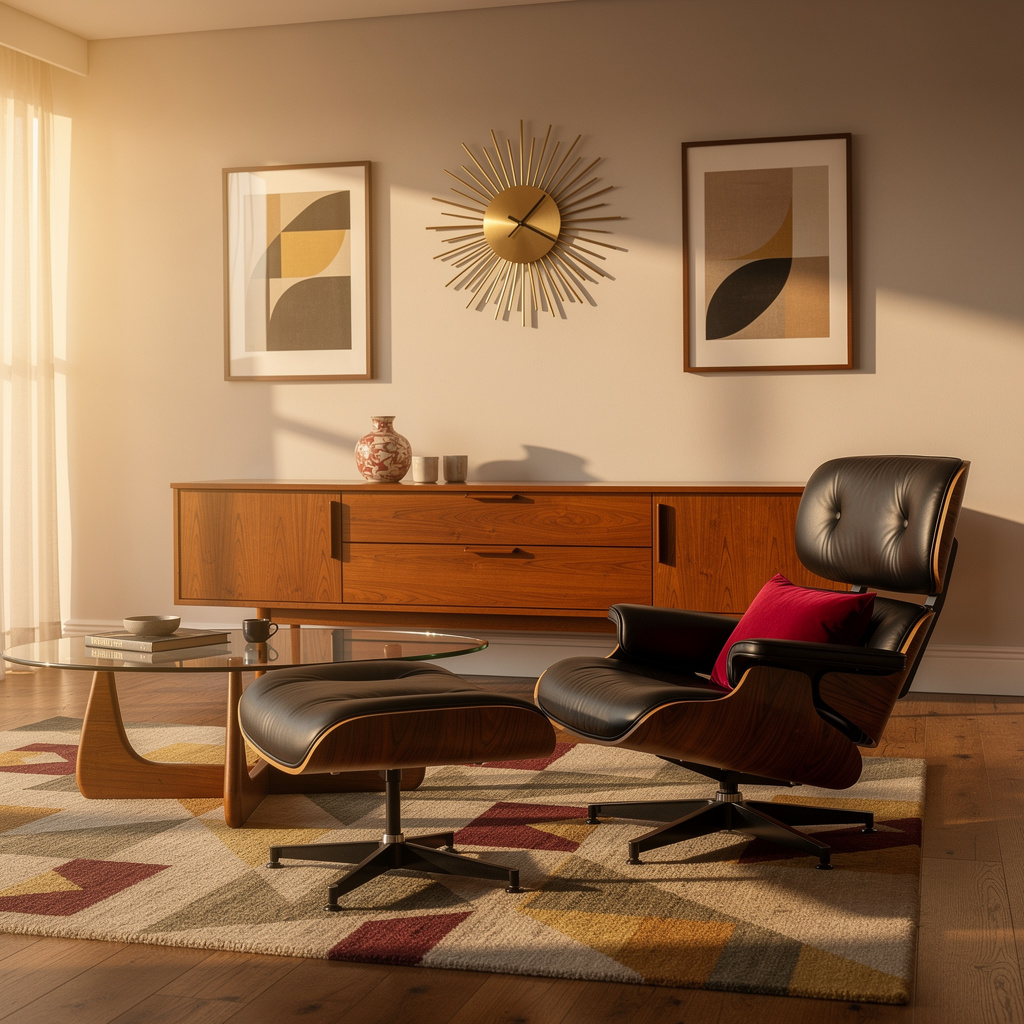
Mid-Century Modern Design is a broad design movement and period style that flourished roughly from the mid-1940s through the late 1960s, spanning architecture, furniture, industrial and product design, graphic design, textiles, interiors, and lighting. Its scope includes residential and commercial buildings, mass-produced and craft-informed furniture, appliances and electronics, visual identity systems, surface patterns, and the integrated domestic environments that brought these elements together. Core concepts include functional clarity, honest use of materials, organic and geometric form, modularity, indoor-outdoor connection, optimistic color and pattern, and the marriage of new industrial techniques with everyday democratic ambition. The subject is not a single uniform style but a set of regional and professional conversations, with American, Scandinavian, and Italian variations responding to different climates, economies, craft traditions, and manufacturing capacities.
Mid-century modern design matters today because its forms, materials, and spatial ideas remain active in contemporary interiors, furniture collections, product design, hospitality, retail branding, and visual identity. In industry, designers and manufacturers continue to revisit mid-century problem-solving around prefabrication, molded materials, modular storage, and human-scaled production, while museums, archives, and academic programs treat the period as a critical chapter in design history, material culture, and conservation. Recent shifts toward sustainable reuse, repair, and circular design have renewed interest in mid-century durability, repairability, and material honesty, and digital catalogues, auctions, and social platforms have expanded both access and the need for reliable connoisseurship. At the same time, conversations about authorship, gender, labor, and global influence are widening the field beyond a narrow canon of iconic chairs and houses.
Mastering this subject builds a skill stack that combines historical contextualization, visual and material literacy, typological knowledge, regional comparison, and evaluative judgment about authenticity, condition, and significance. These capabilities support professional contexts such as interior and architectural practice, product and furniture design, graphics and branding, curation and museum work, conservation, collection management, auction and resale expertise, and design journalism or research. They also benefit personal contexts, including collecting, restoring a home, appraising inherited objects, or simply navigating the many mid-century revivals with a more discerning eye. The bridge from subject to learner outcome is therefore not memorizing a list of famous names, but developing a transferable way of reading designed objects and spaces as evidence of ideas, economies, technologies, and daily life.
What Will This Course Bring You?
- Analyze key historical, social, and technological conditions that produced Mid-Century Modern design across postwar Europe and America.
- Evaluate the defining aesthetic and functional principles of Mid-Century Modernism using criteria such as simplicity, organic form, honesty of materials, and spatial openness.
- Compare residential and commercial architectural expressions of Mid-Century Modernism by identifying structural, site, and facade strategies in representative buildings.
- Evaluate iconic Mid-Century Modern furniture designs in terms of form, material selection, manufacturing constraints, and functional performance.
- Analyze how Mid-Century Modern industrial and graphic designers translated period principles into mass-produced products and visual identity systems.
- Create a repeatable Mid-Century Modern surface pattern that translates period motifs, color relationships, and textile production constraints into a coherent printed or woven design.
- Compare American, Scandinavian, and Italian Mid-Century Modern design variations while assessing how regional material availability and manufacturing innovations shaped their forms.
- Evaluate Mid-Century Modern interiors, lighting, and lifestyle ideals across decline, revival, and contemporary influence, then formulate criteria for collecting and preserving representative design objects.
Curriculum
12 Units1. Foundations: Origins and Historical Context
1 hour
2. Defining Principles and Aesthetic Language
1 hour
3. Architectural Expressions: Residential and Commercial
1 hour
4. Furniture Design Icons: Form, Material, and Function
1 hour
5. Industrial and Product Design: From Appliances to Electronics
1 hour
6. Graphic Design and Visual Identity
1 hour
7. Textile and Surface Pattern Design
1 hour
8. Regional Perspectives: American, Scandinavian, and Italian Variations
1 hour
9. Materials, Techniques, and Manufacturing Innovations
1 hour
10. Interiors, Lighting, and the Mid-Century Lifestyle
1 hour
11. Decline, Revival, and Contemporary Influence
1 hour
12. Collecting, Preserving, and Evaluating Mid-Century Modern Design
1 hour
Exam – Mid-Century Modern Design
20 Questions • 70% Pass • 30 min
Unlock All Units for Free
Create an account, enroll in the course, and start with the first unit right away.
Exam – Mid-Century Modern Design
20 Questions • Pass: 70% • 30 min
Course Duration
720
Total Minutes
12
Unit
1
Final Exam
~60
Min / Unit
Mid-Century Modern Design Certificate Program
Document Your Skill
Those who pass the 20-question, 30-minute exam with 70% receive the Mid-Century Modern Design Certificate.
Stand Out on Your CV
By adding your certificate to your CV, gain a professional reference in job applications and stand out from the crowd.
Career Advantage
With the verification code, employers can check your certificate instantly — a concrete way to show your growth.
CERTIFICATE FEE
At the end of the course, an online exam consisting of 20 questions with a 30-minute time limit is given. The exam appears automatically after you complete the topics. Anyone who scores at least 70 out of 100 on the certificate exam is awarded the Mid-Century Modern Design Document (certificate of attendance). You can add the certificate you earn to your CV for job applications in the many sectors listed above, and use it as a reference proving that you took this interactive course.
The Certificate of Achievement you receive with the Mid-Century Modern Design course program holds value that proves your personal and professional development in the business world. By adding it to your CV, it can serve as an important reference in your job applications. Moreover, compared with certificates from other private training institutions, Catch Wisdom certificates are offered to our participants at a much more affordable price.
The Mid-Century Modern Design course certificate is a document that proves, with a unique verification code, that you completed the course. Employers can instantly check its authenticity with this code, which helps you show your development concretely in your job applications.
For more information, we recommend visiting the Support page.
Certificate in 7 Languages
Earning success certificates from our courses is now more meaningful and global. With certificates available in Turkish, English, German, French, Spanish, Arabic, and Russian, we fully unlock the potential of students worldwide.
Why Certificate in 7 Languages?
-
01
Global Skill Development
Receiving your certificates in 7 different languages strengthens your communication skills as you engage with more people worldwide. It lets you operate more confidently and capably on the international stage.
-
02
International Job Opportunities
Employers may see your certificates in multiple languages as a sign of your ability to seize global opportunities. You can open more doors to new jobs and projects.
-
03
Cultural Richness
The chance to earn certificates in different languages helps you build closer ties with various cultures and broadens your worldview. It enriches your global perspective and deepens cultural understanding.
-
04
Ability to Participate in International Projects
Multilingual certificates give you an edge to work more effectively on international projects. They boost your chances of leadership and participation in diverse projects in the business world.
-
05
Prove Yourself on the Global Stage
Certificates in multiple languages give you the opportunity to present your skills and knowledge worldwide.
Language diversity opens worldwide opportunities. If you want to prove yourself in the international arena, join our online Mid-Century Modern Design course program and begin this journey with us.
Frequently Asked Questions (FAQ)
Is this course paid?
How do I join the course?
Can I take the course at my own pace?
How can I get my certificate?
What are the advantages of the certificate?
Boost Your Career
Take a new career step with the Mid-Century Modern Design course. Add your certificate to your CV, stand out in job applications, and open the door to new opportunities in the industry.
StartStudent Reviews
No reviews yet
Enroll in this course and be the first to leave a review about your experience with Mid-Century Modern Design.
Start