What is Needle Felting?
Needle Felting Training Program
Needle Felting certificate program offers a comprehensive, hands-on journey from the very first stab of the needle to sculpting intricate, poseable characters. Designed for absolute beginners and intermediate crafters alike, this program transforms raw wool into expressive art through a carefully sequenced curriculum covering tools, safety, core stabbing techniques, flat 2D designs, and fully dimensional 3D forms. By the end, you will have completed a finished felted animal or character, equipped with the confidence to design your own original pieces.
The program is structured as a progressive, beginner-friendly pathway that balances theory with immediate practice. Each lesson builds on the last, starting with essential tool selection and wool types, then moving through flat felting, 3D core construction, color blending, facial detailing, wire armatures for poseable sculptures, and advanced texture work for fur and fleece. With dedicated lessons on troubleshooting and creative exploration, this certificate program ensures you master the four core skill areas of shaping, blending, detailing, and finishing—making it the ideal choice for anyone seeking a structured, skill-rich creative outlet in today's maker-driven world.
What is Needle Felting?
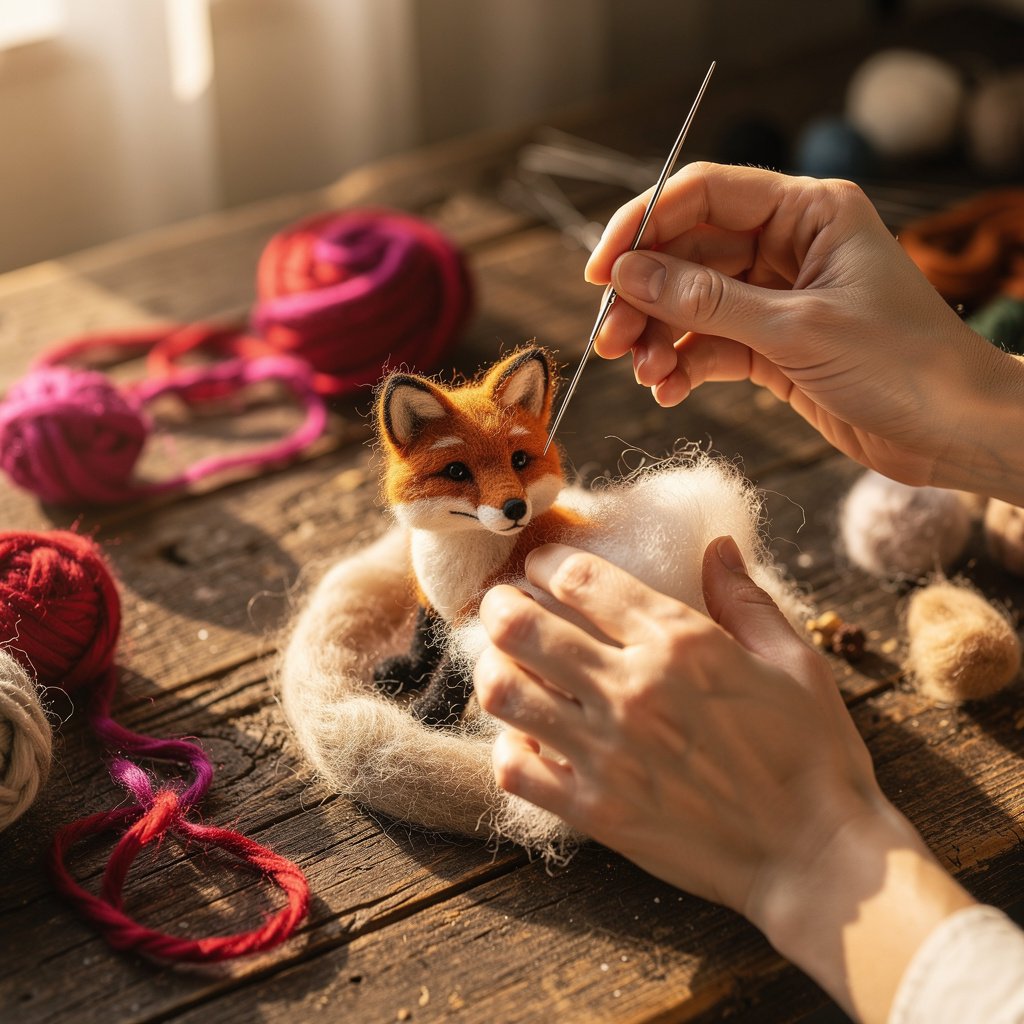
Needle felting is a dry felting technique that uses barbed needles to interlock and compact wool fibers into a dense, sculptural material. Unlike wet felting, which uses soap and water, needle felting relies on repeated piercing to tangle the fibers, allowing for precise control over shape, texture, and detail. The core concepts include understanding wool's natural scales, needle gauge selection, and the mechanics of stabbing at various angles to achieve different effects—from flat, smooth surfaces to fluffy, textured fur.
Today, needle felting has surged in popularity as a versatile medium for both fine art and craft. It is used by contemporary artists to create realistic animal sculptures, miniature dioramas, and wearable art, while also appearing in therapeutic settings for its calming, repetitive motion. The craft has evolved from traditional folk techniques to a modern practice embraced by online communities, workshops, and even academic textile programs, reflecting a broader shift toward sustainable, tactile making in a digital age.
Mastering needle felting builds a unique skill stack that combines fine motor control, spatial reasoning, and an understanding of material properties. Practitioners develop patience, attention to detail, and creative problem-solving as they manipulate wool into three-dimensional forms. This expertise benefits personal projects, professional artistry, or even entrepreneurial ventures in handmade goods, offering a deeply satisfying blend of technical precision and artistic expression that can be applied across countless creative contexts.
Common Questions About Needle Felting
Does the needle felting certificate help my CV for creative job applications?
Can a complete beginner start this needle felting course with no prior craft experience?
Why does the stabbing motion need to go straight in and straight out?
What is the difference between triangle and star needle shapes?
How do you choose the right core wool for a 3D needle felting form?
How does wire armature thickness affect poseable needle felted sculptures?
Is needle felting just stabbing wool until it looks like an animal?
What Will This Course Bring You?
- Analyze the properties of different wool types and select appropriate tools for safe needle felting.
- Apply core stabbing, rolling, and shaping techniques to form basic three-dimensional shapes.
- Design flat felted pictures by layering colored wool fibers to create 2D designs.
- Build a 3D character from a core shape, adding volume and proportion.
- Evaluate color combinations and blending methods to achieve realistic shading in felted pieces.
- Implement wire armatures to create poseable sculptures with dynamic and expressive poses.
- Create realistic fur, hair, and fleece textures using specialized needle felting techniques.
- Apply finishing techniques such as smoothing, trimming, and embellishing to polish a felted project.
Curriculum
12 Units1. Needle Felting Essentials: Tools, Wool, and Safety
1 hour
2. Core Techniques: Stabbing, Rolling, and Shaping
1 hour
3. Flat Felting: Creating 2D Designs and Pictures
1 hour
4. Building 3D Forms: From Core to Character
1 hour
5. Color Theory and Blending for Felting
1 hour
6. Adding Facial Features and Small Details
1 hour
7. Wire Armatures: Poseable Sculptures
1 hour
8. Textures and Surface Effects: Fur, Hair, and Fleece
1 hour
9. Advanced Sculpting: Realism and Complex Anatomy
1 hour
10. Finishing Touches: Smoothing, Trimming, and Embellishments
1 hour
11. Project: Felted Animal or Character
1 hour
12. Troubleshooting and Creative Exploration
1 hour
Exam – Needle Felting
20 Questions • 70% Pass • 30 min
Unlock All Units for Free
Create an account, enroll in the course, and start with the first unit right away.
Exam – Needle Felting
20 Questions • Pass: 70% • 30 min
Course Duration
720
Total Minutes
12
Unit
1
Final Exam
~60
Min / Unit
Needle Felting Certificate Program
Document Your Skill
Those who pass the 20-question, 30-minute exam with 70% receive the Needle Felting Certificate.
Stand Out on Your CV
By adding your certificate to your CV, gain a professional reference in job applications and stand out from the crowd.
Career Advantage
Catch Wisdom certificates are recognized by HR departments and increase career opportunities.
CERTIFICATE FEE
At the end of the course, an online exam consisting of 20 questions with a 30-minute time limit is given. The exam appears automatically after you complete the topics. Anyone who scores at least 70 out of 100 on the certificate exam is awarded the Needle Felting Document (certificate of attendance). You can add the certificate you earn to your CV for job applications in the many sectors listed above, and use it as a reference proving that you took this interactive course.
The Certificate of Achievement you receive with the Needle Felting course program holds value that proves your personal and professional development in the business world. By adding it to your CV, it can serve as an important reference in your job applications. Moreover, compared with certificates from other private training institutions, Catch Wisdom certificates are offered to our participants at a much more affordable price.
Because HR departments recognize Catch Wisdom as a reputable institution in this field, they value these certificates and may evaluate your job applications favorably. For this reason, a Needle Felting course certificate from Catch Wisdom can make your applications more attractive and place you in an advantageous position in the business world.
For more information, we recommend visiting the Support page.
Certificate in 7 Languages
Earning success certificates from our courses is now more meaningful and global. With certificates available in Turkish, English, German, French, Spanish, Arabic, and Russian, we fully unlock the potential of students worldwide.
Why Certificate in 7 Languages?
-
01
Global Skill Development
Receiving your certificates in 7 different languages strengthens your communication skills as you engage with more people worldwide. It lets you operate more confidently and capably on the international stage.
-
02
International Job Opportunities
Employers may see your certificates in multiple languages as a sign of your ability to seize global opportunities. You can open more doors to new jobs and projects.
-
03
Cultural Richness
The chance to earn certificates in different languages helps you build closer ties with various cultures and broadens your worldview. It enriches your global perspective and deepens cultural understanding.
-
04
Ability to Participate in International Projects
Multilingual certificates give you an edge to work more effectively on international projects. They boost your chances of leadership and participation in diverse projects in the business world.
-
05
Prove Yourself on the Global Stage
Certificates in multiple languages let you showcase your skills and knowledge worldwide. You can become an internationally recognized professional.
Language diversity opens worldwide opportunities. If you want to prove yourself in the international arena, join our online Needle Felting course program and begin this journey with us.
Frequently Asked Questions (FAQ)
Is this course paid?
How do I join the course?
Can I take the course at my own pace?
How can I get my certificate?
What are the advantages of the Certified Certificate?
Boost Your Career
Take a new career step with the Needle Felting course. Add your certificate to your CV, stand out in job applications, and open the door to new opportunities in the industry.
StartStudent Reviews
No reviews yet
Enroll in this course and be the first to leave a review about your experience with Needle Felting.
Start