Benoît L.
What is Non-Revenue Water Analysis?
Non-Revenue Water Analysis Training
The Non-Revenue Water Analysis certificate program equips water utility professionals, municipal engineers, and infrastructure managers with a comprehensive framework for identifying, quantifying, and reducing water losses across distribution networks. The curriculum spans the full NRW management cycle, from establishing a water balance and calculating NRW percentages to performing minimum night flow analysis, deploying leak detection methods, and implementing pressure management strategies. Participants learn to distinguish between physical losses—such as leaks and bursts—and apparent losses caused by metering inaccuracies and data errors, and to address each category with targeted, cost-effective interventions. The primary practical outcome is the ability to develop a data-driven NRW reduction action plan tailored to any utility's specific conditions, complete with performance indicators, economic justification, and a monitoring framework.
The program is structured as a beginner-friendly progression that moves from foundational concepts in the introductory lessons through advanced topics like smart water technologies, investment planning, and benchmarking. Each module balances theoretical knowledge with real-world case studies and hands-on calculation exercises, ensuring participants can immediately apply their learning to actual network challenges. The five core skill areas developed throughout the program are water balance computation, loss estimation and measurement, leak detection and localization, pressure management, and economic analysis for NRW reduction. With global water scarcity intensifying and regulatory bodies increasingly mandating loss-reduction targets, utilities that master NRW analysis can recover significant revenue while conserving precious resources—making this training a strategic investment for any water sector professional today.
What is Non-Revenue Water Analysis?
Non-Revenue Water Analysis is the systematic assessment of water that is produced and delivered into a distribution network but never generates revenue for the utility. This encompasses physical losses from leaks and pipe bursts, apparent losses from metering inaccuracies, unauthorized consumption, and data handling errors, as well as unbilled authorized consumption such as water used for firefighting or street cleaning. The discipline is built on the international water balance framework, which categorizes all water flows into revenue and non-revenue components, and on performance indicators like the Infrastructure Leakage Index (ILI) and percentage NRW that allow utilities to benchmark their efficiency against peers.
The relevance of NRW analysis has intensified dramatically as climate change exacerbates water scarcity and aging infrastructure in many cities reaches critical failure points. Utilities worldwide lose an estimated 30 to 40 percent of their treated water to leaks and theft, representing billions of dollars in lost revenue and enormous volumes of wasted water each year. The rise of smart water technologies—including acoustic sensors, pressure loggers, and SCADA-based monitoring—has transformed the field, enabling real-time leak detection, predictive maintenance, and continuous performance evaluation. Regulatory frameworks across Europe, North America, and developing nations are increasingly setting binding NRW reduction targets, making this expertise essential for compliance, financial sustainability, and responsible resource stewardship.
Mastering NRW analysis builds a multidisciplinary skill stack that combines hydraulic engineering, data analytics, economic evaluation, and operational management. Professionals who develop these competencies are equipped to lead water loss reduction programs, optimize network performance, and make evidence-based investment decisions that deliver measurable financial and environmental returns. The subject is directly applicable to roles in water utilities, consulting engineering firms, regulatory agencies, and international development organizations, where NRW expertise is in high demand. Beyond professional advancement, this knowledge enables practitioners to contribute meaningfully to global water security and the sustainable management of one of our most vital resources.
Common Questions About Non-Revenue Water Analysis
Does the non-revenue water analysis certificate help with job applications?
Yes, it can strengthen your job application by providing a verifiable reference. The certificate includes a verification code that employers can check online. It demonstrates your commitment to professional development in water loss management. This training is free, fully online, and self-paced, so you can complete it alongside your current job.
Can a beginner with no water network experience start this NRW training?
Absolutely. The learning path starts with foundational concepts like the IWA water balance and builds up gradually. No prior water network experience is required; a basic understanding of math and logic is enough.
How do you calculate non-revenue water using the IWA water balance?
Non-revenue water is calculated using the IWA water balance table, which categorizes all water entering the system. The formula is: NRW = System Input Volume - Billed Authorized Consumption. To break it down:
- Billed authorized consumption: water that is metered and invoiced.
- Unbilled authorized consumption: water used legally but not billed (e.g., firefighting).
- Physical losses: leaks, bursts, and overflow.
- Apparent losses: meter inaccuracies, data errors, and theft.
What is the minimum night flow analysis method for leakage estimation?
Minimum night flow (MNF) analysis estimates leakage by measuring flow during the early morning hours (typically 2-4 a.m.) when legitimate consumption is at its lowest. The method separates constant losses (leaks) from variable demand. The calculation involves subtracting estimated night-time consumption from the measured MNF to derive the leakage rate. This technique is a core part of the 'Minimum Night Flow Analysis' unit, which also covers how to set up a DMA measurement network.
Why does pressure management reduce physical losses in water networks?
Pressure management reduces physical losses because leakage rate is directly proportional to pressure. Higher pressure increases the flow rate through existing leaks and raises the risk of new leaks. By modulating pressure—especially during low-demand periods—you can significantly cut leakage volumes.
How do leak noise correlators pinpoint leaks in buried pipes?
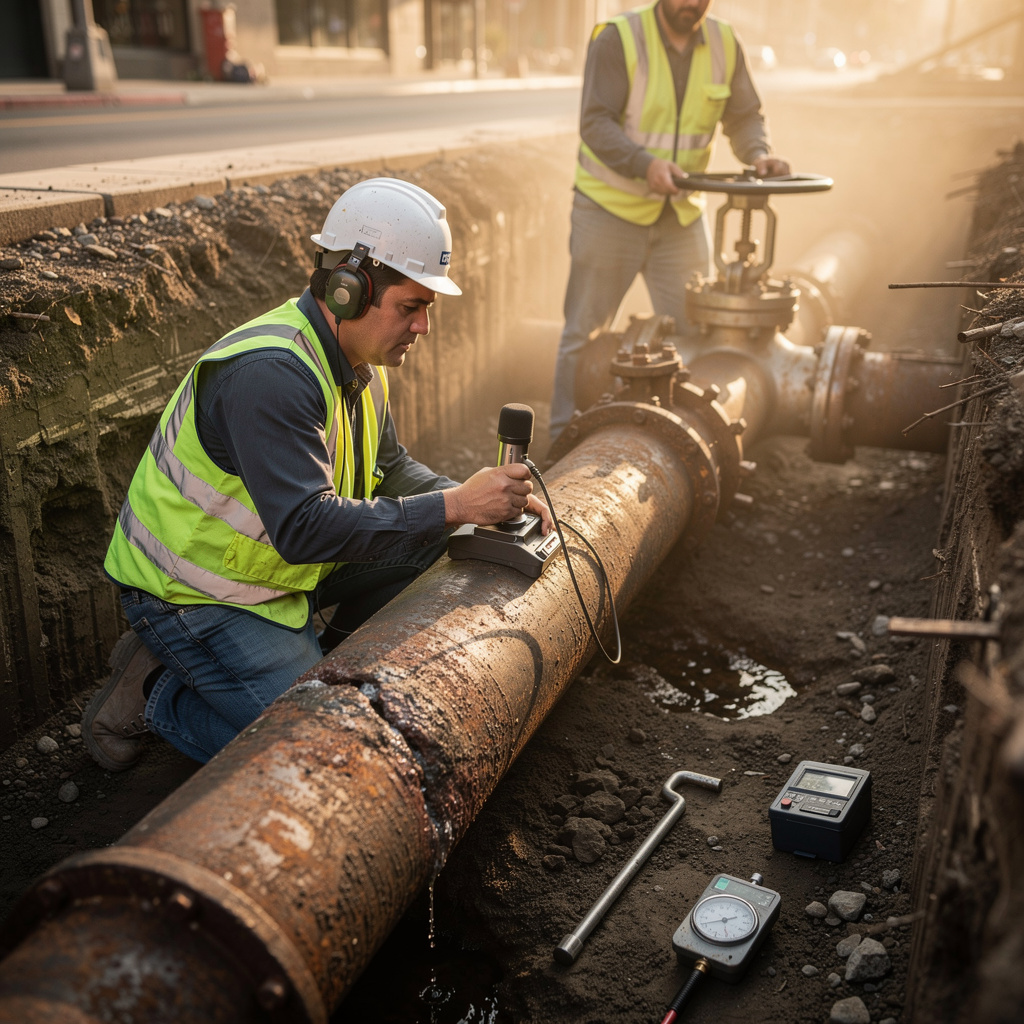
Leak noise correlators use acoustic sensors placed at two points on a pipe. The leak generates a sound that travels to both sensors at different times. The correlator measures the time delay and, knowing the sound speed in the pipe material, calculates the exact leak location.
Is non-revenue water only about leaks and pipe bursts?
No, NRW includes both physical losses (leaks) and apparent losses (metering errors, data errors, and unauthorized consumption). It also encompasses unbilled authorized consumption. So it's a broader concept than just leaks.
What Will This Course Bring You?
- Calculate non-revenue water volume using the standard water balance equation from supply and consumption data.
- Estimate physical losses by analyzing minimum night flow data and applying appropriate leakage estimation techniques.
- Evaluate apparent losses caused by metering inaccuracies and data handling errors to quantify their financial impact.
- Apply leak detection and localization methods such as acoustic and correlator techniques to pinpoint leaks in the network.
- Design a pressure management strategy using pressure-reducing valves to minimize leakage while maintaining adequate service pressure.
- Benchmark NRW performance using key performance indicators and compare results against international standards and best practices.
- Develop a prioritized NRW reduction action plan based on economic analysis, cost-benefit assessment, and investment planning.
- Implement smart water technologies including sensors and analytics for continuous monitoring and evaluation of NRW reduction initiatives.
Curriculum
12 Units
01
1 hour
1. Introduction to Non-Revenue Water
1 hour
02
1 hour
2. Water Balance and NRW Calculation
1 hour
03
1 hour
3. Physical Losses: Sources and Estimation
1 hour
04
1 hour
4. Apparent Losses: Metering and Data Errors
1 hour
05
1 hour
5. Data Collection and Measurement for NRW Analysis
1 hour
06
1 hour
6. Minimum Night Flow Analysis
1 hour
07
1 hour
7. Leak Detection and Localization Methods
1 hour
08
1 hour
8. Pressure Management for Leakage Reduction
1 hour
09
1 hour
9. Performance Indicators and Benchmarking
1 hour
10
1 hour
10. Economic Analysis and Investment Planning
1 hour
11
1 hour
11. Developing an NRW Reduction Action Plan
1 hour
12
1 hour
12. Monitoring, Evaluation, and Smart Water Technologies
1 hour
Exam – Non-Revenue Water Analysis
20 Questions • 70% Pass • 30 min
Unlock All Units for Free
Create an account, enroll in the course, and start with the first unit right away.
Exam – Non-Revenue Water Analysis
20 Questions • Pass: 70% • 30 min
Course Duration
720
Total Minutes
12
Unit
1
Final Exam
~60
Min / Unit
Non-Revenue Water Analysis Certificate Program
Document Your Skill
Those who pass the 20-question, 30-minute exam with 70% receive the Non-Revenue Water Analysis Certificate.
Stand Out on Your CV
By adding your certificate to your CV, gain a professional reference in job applications and stand out from the crowd.
Career Advantage
Catch Wisdom certificates are recognized by HR departments and increase career opportunities.
Sample
CERTIFICATE FEE
110 $
55 $
At the end of the course, an online exam consisting of 20 questions with a 30-minute time limit is given. The exam appears automatically after you complete the topics. Anyone who scores at least 70 out of 100 on the certificate exam is awarded the Non-Revenue Water Analysis Document (certificate of attendance). You can add the certificate you earn to your CV for job applications in the many sectors listed above, and use it as a reference proving that you took this interactive course.
The Certificate of Achievement you receive with the Non-Revenue Water Analysis course program holds value that proves your personal and professional development in the business world. By adding it to your CV, it can serve as an important reference in your job applications. Moreover, compared with certificates from other private training institutions, Catch Wisdom certificates are offered to our participants at a much more affordable price.
Because HR departments recognize Catch Wisdom as a reputable institution in this field, they value these certificates and may evaluate your job applications favorably. For this reason, a Non-Revenue Water Analysis course certificate from Catch Wisdom can make your applications more attractive and place you in an advantageous position in the business world.
For more information, we recommend visiting the Support page.
Certificate in 7 Languages
Earning success certificates from our courses is now more meaningful and global. With certificates available in Turkish, English, German, French, Spanish, Arabic, and Russian, we fully unlock the potential of students worldwide.
Why Certificate in 7 Languages?
-
01
Global Skill Development
Receiving your certificates in 7 different languages strengthens your communication skills as you engage with more people worldwide. It lets you operate more confidently and capably on the international stage.
-
02
International Job Opportunities
Employers may see your certificates in multiple languages as a sign of your ability to seize global opportunities. You can open more doors to new jobs and projects.
-
03
Cultural Richness
The chance to earn certificates in different languages helps you build closer ties with various cultures and broadens your worldview. It enriches your global perspective and deepens cultural understanding.
-
04
Ability to Participate in International Projects
Multilingual certificates give you an edge to work more effectively on international projects. They boost your chances of leadership and participation in diverse projects in the business world.
-
05
Prove Yourself on the Global Stage
Certificates in multiple languages let you showcase your skills and knowledge worldwide. You can become an internationally recognized professional.
Language diversity opens worldwide opportunities. If you want to prove yourself in the international arena, join our online Non-Revenue Water Analysis course program and begin this journey with us.
Frequently Asked Questions (FAQ)
Is this course paid?
No, all courses on Catch Wisdom are completely free to join. We believe education should be accessible to everyone.
How do I join the course?
After creating an account, you can join in one click with the "Start Course" button and begin immediately from the first unit.
Can I take the course at my own pace?
Yes, all courses are designed for self-paced learning. There are no deadlines or time limits.
How can I get my certificate?
After completing the course and passing the final exam, you can order your certificate and instantly download it as PDF.
What are the advantages of the Certified Certificate?
With instant PDF access, validity in 7 languages, a digital signature, and a unique verification code, your certificate becomes a professional reference in job applications.
Boost Your Career
Take a new career step with the Non-Revenue Water Analysis course. Add your certificate to your CV, stand out in job applications, and open the door to new opportunities in the industry.
StartStudent Reviews
5.0
(1 reviews)
5.0
1 reviews
5
100%
4
0%
3
0%
2
0%
1
0%