What is Quilting Basics?
Quilting Basics Certificate Program
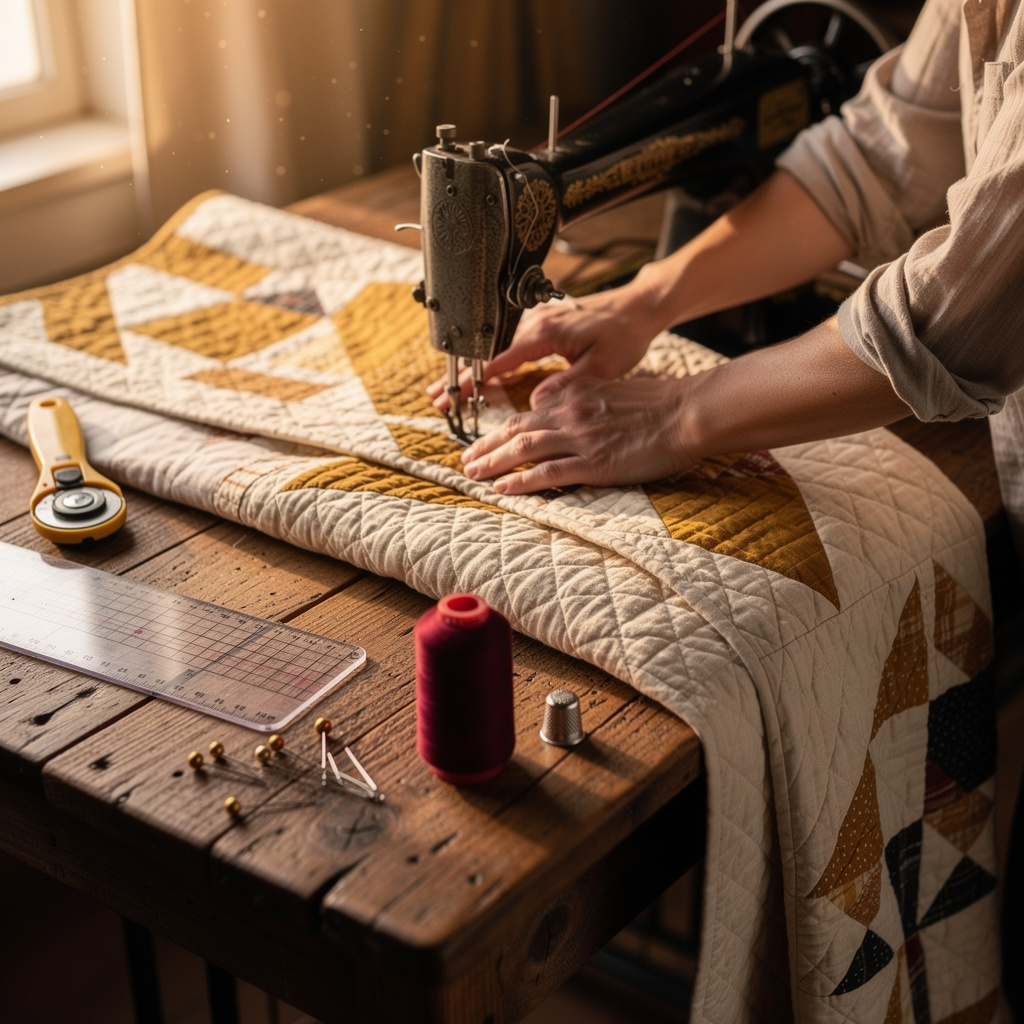
Quilting Basics certificate program is a hands-on training designed for absolute beginners and returning hobbyists who want to master the foundational skills of quilt making from the ground up. The curriculum covers every stage of the quilting process, from setting up your workspace and selecting fabrics with proper grain and preparation, to reading patterns, understanding quilt math, rotary cutting, machine piecing, and constructing classic blocks. You will also learn how to assemble a quilt top with sashing and borders, baste and quilt the layers by machine and hand, and finish with binding, labels, and other details. The main practical outcome is a completed beginner quilt project that demonstrates your ability to confidently plan, cut, piece, quilt, and finish a quilt from start to finish.
The program is structured as a beginner-friendly progression that balances essential theory with immediate hands-on practice. Early lessons build your understanding of color, value, and pattern design alongside the technical skills of accurate rotary cutting and consistent seam allowances. As you advance, you apply these skills to classic quilt blocks, quilt top assembly, and the quilt sandwich, culminating in a full beginner quilt project. The course develops five core skill areas: workspace and tool mastery, fabric selection and preparation, design and pattern literacy, precision piecing and assembly, and finishing techniques for quilting and binding. You would choose this program now because quilting has seen a resurgence as a mindful, creative outlet, and this certificate provides a clear, structured path to avoid common beginner mistakes while producing a finished quilt you can be proud of.
What is Quilting Basics?
Quilting Basics is the foundational practice of creating a quilt—a layered textile made of a top fabric, batting, and backing held together with stitching. It encompasses a wide range of core concepts, including fabric selection based on grain and fiber content, color theory and value contrast for design, pattern reading and quilt math for calculating yardage and block sizes, and precise rotary cutting techniques. The scope also covers machine piecing methods for seams and units, pressing for flat blocks, classic block construction, quilt top assembly with sashing and borders, basting and making the quilt sandwich, and both machine and hand stitching for the quilting layer. Finally, it includes finishing details such as binding, labels, and the overall craftsmanship that turns a pieced top into a durable, beautiful quilt.
Quilting Basics remains highly relevant as a practical craft that combines creativity, precision, and mindfulness in an increasingly digital world. In real life, quilting is used to make bed quilts, wall hangings, wearable art, and gifts, and it supports a thriving industry of fabric shops, longarm quilting services, and online communities. Recent shifts include the rise of modern quilting with bold geometric designs, the use of digital cutting machines and quilting software, and a growing emphasis on sustainable quilting through fabric scraps and upcycled materials. In academia, quilting is studied in textile history, women's studies, and art programs for its cultural significance and mathematical patterning. The subject also matters because it preserves traditional hand skills while adapting to contemporary tools and aesthetics.
Mastering Quilting Basics builds a skill stack that includes spatial reasoning, measurement accuracy, color coordination, manual dexterity, and problem-solving—all transferable to other textile arts and design fields. These skills benefit personal contexts such as making heirloom gifts, decorating a home, or enjoying a meditative hobby, as well as professional contexts like teaching workshops, selling handmade quilts, designing patterns, or working in fabric retail and longarm quilting. The subject also fosters patience and resilience, because every quilt involves iterative learning from cutting errors, seam ripping, and design adjustments. Ultimately, a strong foundation in Quilting Basics empowers individuals to join a global community of makers, contribute to textile traditions, and express personal creativity through functional art.
Common Questions About Quilting Basics
Is the Quilting Basics course suitable for total beginners?
How is the Quilting Basics course structured week by week?
- Foundations: Tools, Supplies, and Workspace Setup, followed by Quilt Fabric Selection, Grain, and Preparation.
- Design and planning: Color, Value, and Pattern in Quilt Design, then Reading Quilt Patterns and Understanding Quilt Math.
- Cutting and piecing: Rotary Cutting and Accurate Fabric Preparation, Machine Piecing, and Classic Quilt Blocks.
- Assembly and finishing: Quilt Top Assembly, Basting and Making the Quilt Sandwich, Machine and Hand Stitching for Quilt Layers, and Binding, Labels, and Finishing Details.
- Capstone: Beginner Quilt Project from Start to Finish.
Why does fabric grain direction change how a quilt behaves?
What is a scant quarter-inch seam allowance in machine piecing?
Why does basting decide if a quilt sandwich stays flat?
When should I use a walking foot for machine quilting?
Do I really need a longarm machine to finish a beginner quilt?
What Will This Course Bring You?
- Set up a quilting workspace and select essential tools and supplies that support safe, accurate cutting, piecing, and pressing.
- Evaluate quilt fabrics for grain, weave, and preparation needs, then prepare yardage by prewashing, starching, and pressing as appropriate.
- Apply color, value, and pattern principles to design a balanced quilt layout that communicates a chosen visual mood or theme.
- Interpret quilt patterns and calculate fabric requirements, cutting dimensions, and block quantities using basic quilt math accurately.
- Demonstrate rotary cutting skills by squaring fabric, aligning rulers safely, and cutting precise strips, squares, and triangles for piecing.
- Construct classic quilt blocks with consistent seam allowances, proper unit assembly, and pressing techniques that keep blocks flat and square.
- Assemble a quilt top by applying sashing, borders, and setting options that align seams and create a cohesive finished composition.
- Complete a beginner quilt from basting through binding and labeling, evaluating stitch quality and finishing details for durable results.
Curriculum
12 Units1. Tools, Supplies, and Workspace Setup
1 hour
2. Quilt Fabric Selection, Grain, and Preparation
1 hour
3. Color, Value, and Pattern in Quilt Design
1 hour
4. Reading Quilt Patterns and Understanding Quilt Math
1 hour
5. Rotary Cutting and Accurate Fabric Preparation
1 hour
6. Machine Piecing: Seams, Units, and Pressing
1 hour
7. Classic Quilt Blocks and Block Construction
1 hour
8. Quilt Top Assembly: Sashing, Borders, and Setting Options
1 hour
9. Basting and Making the Quilt Sandwich
1 hour
10. Machine and Hand Stitching for Quilt Layers
1 hour
11. Binding, Labels, and Finishing Details
1 hour
12. Beginner Quilt Project from Start to Finish
1 hour
Exam – Quilting Basics
20 Questions • 70% Pass • 30 min
Unlock All Units for Free
Create an account, enroll in the course, and start with the first unit right away.
Exam – Quilting Basics
20 Questions • Pass: 70% • 30 min
Course Duration
720
Total Minutes
12
Unit
1
Final Exam
~60
Min / Unit
Quilting Basics Certificate Program
Document Your Skill
Those who pass the 20-question, 30-minute exam with 70% receive the Quilting Basics Certificate.
Stand Out on Your CV
By adding your certificate to your CV, gain a professional reference in job applications and stand out from the crowd.
Career Advantage
With the verification code, employers can check your certificate instantly — a concrete way to show your growth.
CERTIFICATE FEE
At the end of the course, an online exam consisting of 20 questions with a 30-minute time limit is given. The exam appears automatically after you complete the topics. Anyone who scores at least 70 out of 100 on the certificate exam is awarded the Quilting Basics Document (certificate of attendance). You can add the certificate you earn to your CV for job applications in the many sectors listed above, and use it as a reference proving that you took this interactive course.
The Certificate of Achievement you receive with the Quilting Basics course program holds value that proves your personal and professional development in the business world. By adding it to your CV, it can serve as an important reference in your job applications. Moreover, compared with certificates from other private training institutions, Catch Wisdom certificates are offered to our participants at a much more affordable price.
The Quilting Basics course certificate is a document that proves, with a unique verification code, that you completed the course. Employers can instantly check its authenticity with this code, which helps you show your development concretely in your job applications.
For more information, we recommend visiting the Support page.
Certificate in 7 Languages
Earning success certificates from our courses is now more meaningful and global. With certificates available in Turkish, English, German, French, Spanish, Arabic, and Russian, we fully unlock the potential of students worldwide.
Why Certificate in 7 Languages?
-
01
Global Skill Development
Receiving your certificates in 7 different languages strengthens your communication skills as you engage with more people worldwide. It lets you operate more confidently and capably on the international stage.
-
02
International Job Opportunities
Employers may see your certificates in multiple languages as a sign of your ability to seize global opportunities. You can open more doors to new jobs and projects.
-
03
Cultural Richness
The chance to earn certificates in different languages helps you build closer ties with various cultures and broadens your worldview. It enriches your global perspective and deepens cultural understanding.
-
04
Ability to Participate in International Projects
Multilingual certificates give you an edge to work more effectively on international projects. They boost your chances of leadership and participation in diverse projects in the business world.
-
05
Prove Yourself on the Global Stage
Certificates in multiple languages give you the opportunity to present your skills and knowledge worldwide.
Language diversity opens worldwide opportunities. If you want to prove yourself in the international arena, join our online Quilting Basics course program and begin this journey with us.
Frequently Asked Questions (FAQ)
Is this course paid?
How do I join the course?
Can I take the course at my own pace?
How can I get my certificate?
What are the advantages of the certificate?
Boost Your Career
Take a new career step with the Quilting Basics course. Add your certificate to your CV, stand out in job applications, and open the door to new opportunities in the industry.
StartStudent Reviews
No reviews yet
Enroll in this course and be the first to leave a review about your experience with Quilting Basics.
Start