What is Recirculating Aquaculture Systems?
Recirculating Aquaculture Systems Training
The Recirculating Aquaculture Systems certificate program delivers a complete, practical foundation for designing, operating, and troubleshooting modern land-based fish farms. Built for aquaculture technicians, farm managers, environmental engineers, and aspiring entrepreneurs, this course transforms theoretical knowledge into actionable skills for real-world RAS facilities. By the end, participants will be able to monitor water quality, optimize biological filtration, manage solids, and maintain healthy fish populations under intensive production conditions.
The program is structured as a beginner-friendly progression, moving from core principles like water quality parameters and mechanical filtration to advanced topics such as CO2 stripping, system automation, and economic feasibility. Each of the twelve lessons balances scientific theory with hands-on operational guidance, building four key skill areas: water chemistry management, system component integration, fish health and biosecurity, and troubleshooting/design optimization. With the global shift toward sustainable, land-based aquaculture, this training equips you to meet the rising demand for controlled-environment food production—making now the ideal time to master RAS.
What is Recirculating Aquaculture Systems?
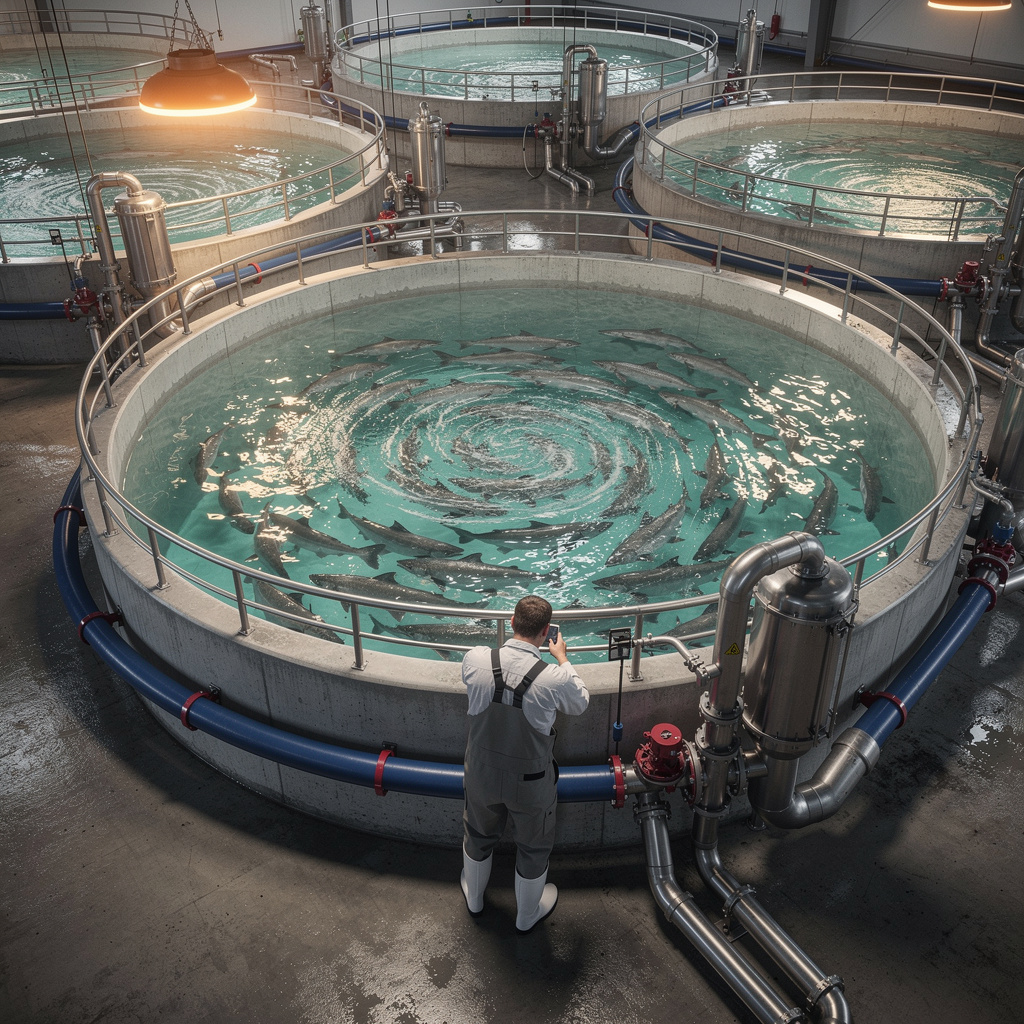
Recirculating Aquaculture Systems (RAS) are closed-loop fish farming environments that continuously filter and reuse water, allowing high-density production with minimal water exchange. The core concept involves a series of treatment processes—mechanical filtration to remove solids, biological filtration to convert toxic ammonia into nitrate, aeration to maintain dissolved oxygen, and CO2 stripping to control pH—all integrated into a single engineered system. RAS also encompasses system configuration, stocking density management, and automated monitoring to maintain optimal conditions for aquatic species.
Today, RAS is at the forefront of sustainable aquaculture, addressing critical challenges like water scarcity, environmental pollution, and disease outbreaks that plague open-net pens and flow-through farms. It is used commercially for species such as salmon, tilapia, shrimp, and ornamental fish, and is increasingly adopted in urban vertical farms and research institutions. Recent advances in sensor technology, machine learning, and recirculating design have made RAS more energy-efficient and economically viable, shifting the industry toward land-based production that can be located near consumers.
Mastering RAS builds a multidisciplinary skill stack that combines aquatic biology, mechanical engineering, water chemistry, and data-driven process control. Professionals with this expertise are sought after in aquaculture operations, equipment manufacturing, consulting firms, and regulatory agencies. Beyond commercial careers, understanding RAS empowers hobbyists and community projects to raise fish responsibly, while also contributing to global food security and climate resilience. The subject offers a tangible pathway to innovate in one of the fastest-growing sectors of agriculture.
Common Questions About Recirculating Aquaculture Systems
What does the RAS certificate add to a CV for aquaculture jobs?
Is the RAS course suitable for beginners with no fish farming background?
Why does the drum filter come before the biofilter in a RAS loop?
How does the biofilter convert ammonia to nitrate in RAS?
- Ammonia-oxidizing bacteria (AOB): convert toxic ammonia (NH₃) into nitrite (NO₂⁻).
- Nitrite-oxidizing bacteria (NOB): convert nitrite into the far less toxic nitrate (NO₃⁻).
What is the 30-minute window in RAS aeration design?
How do you size oxygenation based on feed rate in RAS?
Is recirculating aquaculture systems only for areas with no water?
What Will This Course Bring You?
- Analyze the fundamental processes and components that define a recirculating aquaculture system.
- Evaluate water quality parameters such as ammonia, nitrite, nitrate, and dissolved oxygen to determine system health.
- Design a mechanical filtration system to remove suspended solids from recirculating aquaculture water.
- Apply nitrification principles to optimize biological filtration and manage nitrogenous waste in RAS.
- Implement aeration and oxygenation strategies to maintain adequate dissolved oxygen levels for fish health.
- Evaluate CO2 stripping methods and pH control techniques to stabilize water chemistry in RAS.
- Develop biosecurity protocols to prevent disease outbreaks and maintain fish health in recirculating systems.
- Analyze the economic feasibility and design considerations for scaling a recirculating aquaculture system.
Curriculum
12 Units1. Fundamentals of Recirculating Aquaculture Systems
1 hour
2. Water Quality Parameters and Monitoring
1 hour
3. Mechanical Filtration
1 hour
4. Biological Filtration and Nitrification
1 hour
5. Aeration and Oxygenation
1 hour
6. CO2 Stripping and pH Control
1 hour
7. System Components and Configuration
1 hour
8. Stocking Density and Carrying Capacity
1 hour
9. Fish Health and Biosecurity in RAS
1 hour
10. Solids Management and Waste Treatment
1 hour
11. System Control and Automation
1 hour
12. Design, Economics, and Troubleshooting
1 hour
Exam – Recirculating Aquaculture Systems
20 Questions • 70% Pass • 30 min
Unlock All Units for Free
Create an account, enroll in the course, and start with the first unit right away.
Exam – Recirculating Aquaculture Systems
20 Questions • Pass: 70% • 30 min
Course Duration
720
Total Minutes
12
Unit
1
Final Exam
~60
Min / Unit
Recirculating Aquaculture Systems Certificate Program
Document Your Skill
Those who pass the 20-question, 30-minute exam with 70% receive the Recirculating Aquaculture Systems Certificate.
Stand Out on Your CV
By adding your certificate to your CV, gain a professional reference in job applications and stand out from the crowd.
Career Advantage
Catch Wisdom certificates are recognized by HR departments and increase career opportunities.
CERTIFICATE FEE
At the end of the course, an online exam consisting of 20 questions with a 30-minute time limit is given. The exam appears automatically after you complete the topics. Anyone who scores at least 70 out of 100 on the certificate exam is awarded the Recirculating Aquaculture Systems Document (certificate of attendance). You can add the certificate you earn to your CV for job applications in the many sectors listed above, and use it as a reference proving that you took this interactive course.
The Certificate of Achievement you receive with the Recirculating Aquaculture Systems course program holds value that proves your personal and professional development in the business world. By adding it to your CV, it can serve as an important reference in your job applications. Moreover, compared with certificates from other private training institutions, Catch Wisdom certificates are offered to our participants at a much more affordable price.
Because HR departments recognize Catch Wisdom as a reputable institution in this field, they value these certificates and may evaluate your job applications favorably. For this reason, a Recirculating Aquaculture Systems course certificate from Catch Wisdom can make your applications more attractive and place you in an advantageous position in the business world.
For more information, we recommend visiting the Support page.
Certificate in 7 Languages
Earning success certificates from our courses is now more meaningful and global. With certificates available in Turkish, English, German, French, Spanish, Arabic, and Russian, we fully unlock the potential of students worldwide.
Why Certificate in 7 Languages?
-
01
Global Skill Development
Receiving your certificates in 7 different languages strengthens your communication skills as you engage with more people worldwide. It lets you operate more confidently and capably on the international stage.
-
02
International Job Opportunities
Employers may see your certificates in multiple languages as a sign of your ability to seize global opportunities. You can open more doors to new jobs and projects.
-
03
Cultural Richness
The chance to earn certificates in different languages helps you build closer ties with various cultures and broadens your worldview. It enriches your global perspective and deepens cultural understanding.
-
04
Ability to Participate in International Projects
Multilingual certificates give you an edge to work more effectively on international projects. They boost your chances of leadership and participation in diverse projects in the business world.
-
05
Prove Yourself on the Global Stage
Certificates in multiple languages let you showcase your skills and knowledge worldwide. You can become an internationally recognized professional.
Language diversity opens worldwide opportunities. If you want to prove yourself in the international arena, join our online Recirculating Aquaculture Systems course program and begin this journey with us.
Frequently Asked Questions (FAQ)
Is this course paid?
How do I join the course?
Can I take the course at my own pace?
How can I get my certificate?
What are the advantages of the Certified Certificate?
Boost Your Career
Take a new career step with the Recirculating Aquaculture Systems course. Add your certificate to your CV, stand out in job applications, and open the door to new opportunities in the industry.
StartStudent Reviews
No reviews yet
Enroll in this course and be the first to leave a review about your experience with Recirculating Aquaculture Systems.
Start