What is Rooftop Farming Techniques?
Rooftop Farming Techniques Training
The Rooftop Farming Techniques certificate program teaches you how to transform underutilized urban rooftops into productive, sustainable growing spaces. Designed for urban gardeners, sustainability professionals, and aspiring commercial growers, this course delivers a practical outcome: the ability to plan, install, and manage a thriving rooftop farm from start to finish. Through lessons on site assessment, container selection, irrigation design, and crop choice, you gain the hands-on knowledge needed to turn concrete into fertile ground.
The program follows a beginner-friendly progression that balances theory with real-world application, building core skills in structural evaluation, growing systems, crop management, pest control, and long-term maintenance. You will explore season extension techniques and post-harvest handling, ensuring your harvest reaches its full potential. With urban food demand rising and green space shrinking, this training equips you to lead the rooftop farming movement—whether on a single residential terrace or a large commercial building.
What is Rooftop Farming Techniques?
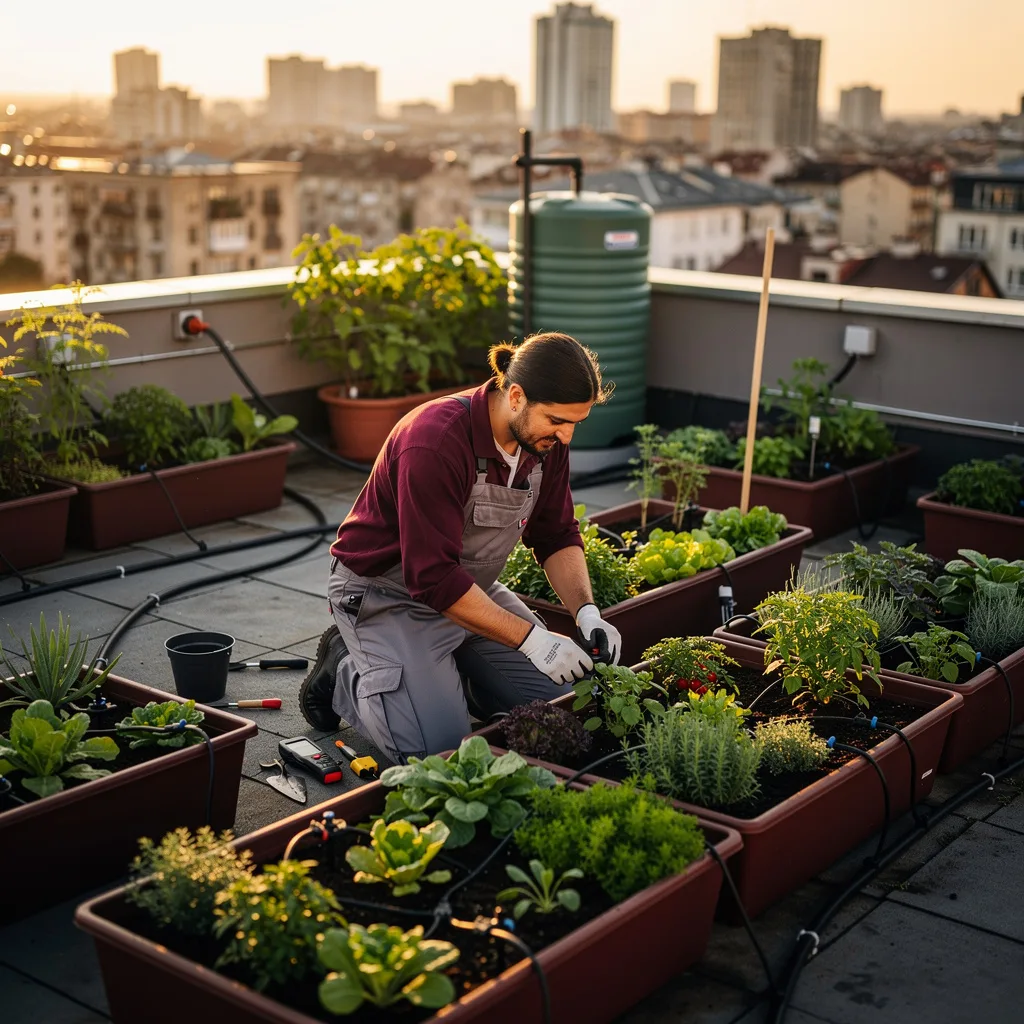
Rooftop farming techniques encompass the specialized methods used to cultivate food and plants on building rooftops, integrating horticulture, engineering, and environmental science. Core concepts include assessing structural load capacity, designing water-efficient irrigation systems, selecting lightweight growing substrates, and choosing crops that tolerate wind, sun exposure, and limited soil depth. This discipline also covers soil and nutrient management, pest and disease control in elevated environments, and strategies to extend the growing season through protective covers or microclimates.
Today, rooftop farming matters because it addresses critical urban challenges: food security, heat island effect, stormwater management, and local food access. Real-world applications range from community gardens on apartment buildings to large-scale commercial farms on warehouses and hotels, with universities researching optimal yields and carbon sequestration. Recent shifts toward climate-resilient cities and circular economies have accelerated investment in green roofs and rooftop agriculture, making these techniques more relevant than ever.
Mastering rooftop farming techniques builds a versatile skill stack that includes structural assessment, hydroponic and soil-based growing, irrigation engineering, and ecological pest management. Professionals in urban planning, architecture, landscape design, and food systems benefit directly, while hobbyists gain the confidence to grow fresh produce in dense cities. This knowledge empowers individuals to create productive green spaces that improve local resilience, reduce food miles, and foster community engagement—all from the skyline.
Common Questions About Rooftop Farming Techniques
Does the Rooftop Farming certificate boost your resume for urban agriculture jobs?
What practical skills does the Rooftop Farming Techniques course teach?
- Site Assessment: Evaluating structural load, sun exposure, and wind patterns using the Load-Bearing Assessment Flow.
- Container and Substrate Selection: Choosing appropriate containers and engineered substrates based on depth categories.
- Irrigation Design: Installing drip irrigation systems tailored to rooftop constraints.
- Crop Selection: Identifying wind-resistant varieties and matching crops to rooftop microclimates.
- Soil and Nutrient Management: Using technosols and managing nutrient cycling.
- Pest Management: Applying IPM strategies for common rooftop pests.
- Season Extension: Using techniques like succession planting and cold-resistant varieties.
- Harvesting and Post-Harvest Handling: Timing harvests and proper washing procedures.
How do you calculate load-bearing capacity for a rooftop farm?
What substrate depth is needed for growing tomatoes on a rooftop?
Why is drip irrigation the gold standard for rooftop farming?
- Water Efficiency: Delivers water directly to the root zone, minimizing evaporation and runoff.
- Weight Reduction: Uses lightweight tubing instead of heavy overhead systems, reducing structural load.
- Wind Resistance: Low-profile design avoids wind damage and water drift.
- Precision: Allows precise control over watering schedules and amounts.
Which crops are most wind-resistant for rooftop conditions?
Can you use regular garden soil on a rooftop farm?
What Will This Course Bring You?
- Assess rooftop structural load capacity and environmental conditions to determine suitability for farming.
- Design an efficient rooftop layout that optimizes sunlight exposure and access for maintenance.
- Select appropriate growing containers and substrates tailored to rooftop weight and drainage constraints.
- Implement a drip irrigation system with rainwater harvesting to maximize water efficiency on rooftops.
- Evaluate crop varieties based on rooftop microclimate factors such as wind, heat, and light intensity.
- Apply integrated pest management strategies to control common rooftop pests without chemical pesticides.
- Plan season extension techniques using row covers or cold frames to extend the growing period on rooftops.
Curriculum
12 Units1. Overview and Benefits of Rooftop Farming
1 hour
2. Assessing Rooftop Suitability
1 hour
3. Designing the Rooftop Layout
1 hour
4. Growing Containers and Substrates
1 hour
5. Irrigation Systems for Rooftops
1 hour
6. Selecting Crops for Rooftop Conditions
1 hour
7. Soil and Nutrient Management
1 hour
8. Pest and Disease Management
1 hour
9. Season Extension Techniques
1 hour
10. Harvesting and Post-Harvest Handling
1 hour
11. Community and Commercial Rooftop Farming
1 hour
12. Maintenance and Long-Term Sustainability
1 hour
Exam – Rooftop Farming Techniques
20 Questions • 70% Pass • 30 min
Unlock All Units for Free
Create an account, enroll in the course, and start with the first unit right away.
Exam – Rooftop Farming Techniques
20 Questions • Pass: 70% • 30 min
Course Duration
720
Total Minutes
12
Unit
1
Final Exam
~60
Min / Unit
Rooftop Farming Techniques Certificate Program
Document Your Skill
Those who pass the 20-question, 30-minute exam with 70% receive the Rooftop Farming Techniques Certificate.
Stand Out on Your CV
By adding your certificate to your CV, gain a professional reference in job applications and stand out from the crowd.
Career Advantage
With the verification code, employers can check your certificate instantly — a concrete way to show your growth.
CERTIFICATE FEE
At the end of the course, an online exam consisting of 20 questions with a 30-minute time limit is given. The exam appears automatically after you complete the topics. Anyone who scores at least 70 out of 100 on the certificate exam is awarded the Rooftop Farming Techniques Document (certificate of attendance). You can add the certificate you earn to your CV for job applications in the many sectors listed above, and use it as a reference proving that you took this interactive course.
The Certificate of Achievement you receive with the Rooftop Farming Techniques course program holds value that proves your personal and professional development in the business world. By adding it to your CV, it can serve as an important reference in your job applications. Moreover, compared with certificates from other private training institutions, Catch Wisdom certificates are offered to our participants at a much more affordable price.
The Rooftop Farming Techniques course certificate is a document that proves, with a unique verification code, that you completed the course. Employers can instantly check its authenticity with this code, which helps you show your development concretely in your job applications.
For more information, we recommend visiting the Support page.
Certificate in 7 Languages
Earning success certificates from our courses is now more meaningful and global. With certificates available in Turkish, English, German, French, Spanish, Arabic, and Russian, we fully unlock the potential of students worldwide.
Why Certificate in 7 Languages?
-
01
Global Skill Development
Receiving your certificates in 7 different languages strengthens your communication skills as you engage with more people worldwide. It lets you operate more confidently and capably on the international stage.
-
02
International Job Opportunities
Employers may see your certificates in multiple languages as a sign of your ability to seize global opportunities. You can open more doors to new jobs and projects.
-
03
Cultural Richness
The chance to earn certificates in different languages helps you build closer ties with various cultures and broadens your worldview. It enriches your global perspective and deepens cultural understanding.
-
04
Ability to Participate in International Projects
Multilingual certificates give you an edge to work more effectively on international projects. They boost your chances of leadership and participation in diverse projects in the business world.
-
05
Prove Yourself on the Global Stage
Certificates in multiple languages give you the opportunity to present your skills and knowledge worldwide.
Language diversity opens worldwide opportunities. If you want to prove yourself in the international arena, join our online Rooftop Farming Techniques course program and begin this journey with us.
Frequently Asked Questions (FAQ)
Is this course paid?
How do I join the course?
Can I take the course at my own pace?
How can I get my certificate?
What are the advantages of the certificate?
Boost Your Career
Take a new career step with the Rooftop Farming Techniques course. Add your certificate to your CV, stand out in job applications, and open the door to new opportunities in the industry.
StartStudent Reviews
No reviews yet
Enroll in this course and be the first to leave a review about your experience with Rooftop Farming Techniques.
Start