What is Sourdough Bread Baking?
Sourdough Bread Baking Training
The Sourdough Bread Baking certificate program teaches the full arc of naturally leavened bread production, from selecting ingredients and setting up a workspace to building and reviving a starter, managing fermentation, mixing and developing gluten, shaping, proofing, scoring, and baking. It is designed for home bakers who want dependable results, culinary students and bakery staff who need process discipline, and cottage-food or test-kitchen cooks who want to adapt recipes with evidence rather than guesswork. Learners work through fermentation science and microbial activity alongside hands-on dough handling, so they can read a starter, judge gluten development, control bulk fermentation and cold retard, and evaluate crumb, crust, and flavor. The main practical outcome is the ability to bake consistent sourdough loaves and troubleshoot variables such as hydration, temperature, flour choice, and timing, then adapt formulas to whole-grain variations and repeatable routines.
The program is structured as a beginner-friendly progression: it begins with ingredients, tools, and workspace setup, then moves into building a starter from scratch and maintaining or reviving it before introducing fermentation science and microbial activity. From there, lessons build in sequence through mixing and gluten development, bulk fermentation and folding, pre-shaping and shaping, final proofing and cold retard, scoring and oven baking, and evaluating crumb, crust, and flavor. Theory and practice are balanced throughout, with scientific explanations tied to observable dough cues and with troubleshooting and recipe adaptation treated as core skills rather than afterthoughts. The curriculum builds five core skill areas—starter management, fermentation control, dough handling and shaping, bake evaluation, and recipe adaptation—and it is worth choosing now because demand for artisan and home-baked bread, whole-grain baking, and reproducible small-batch production continues to grow.
What is Sourdough Bread Baking?
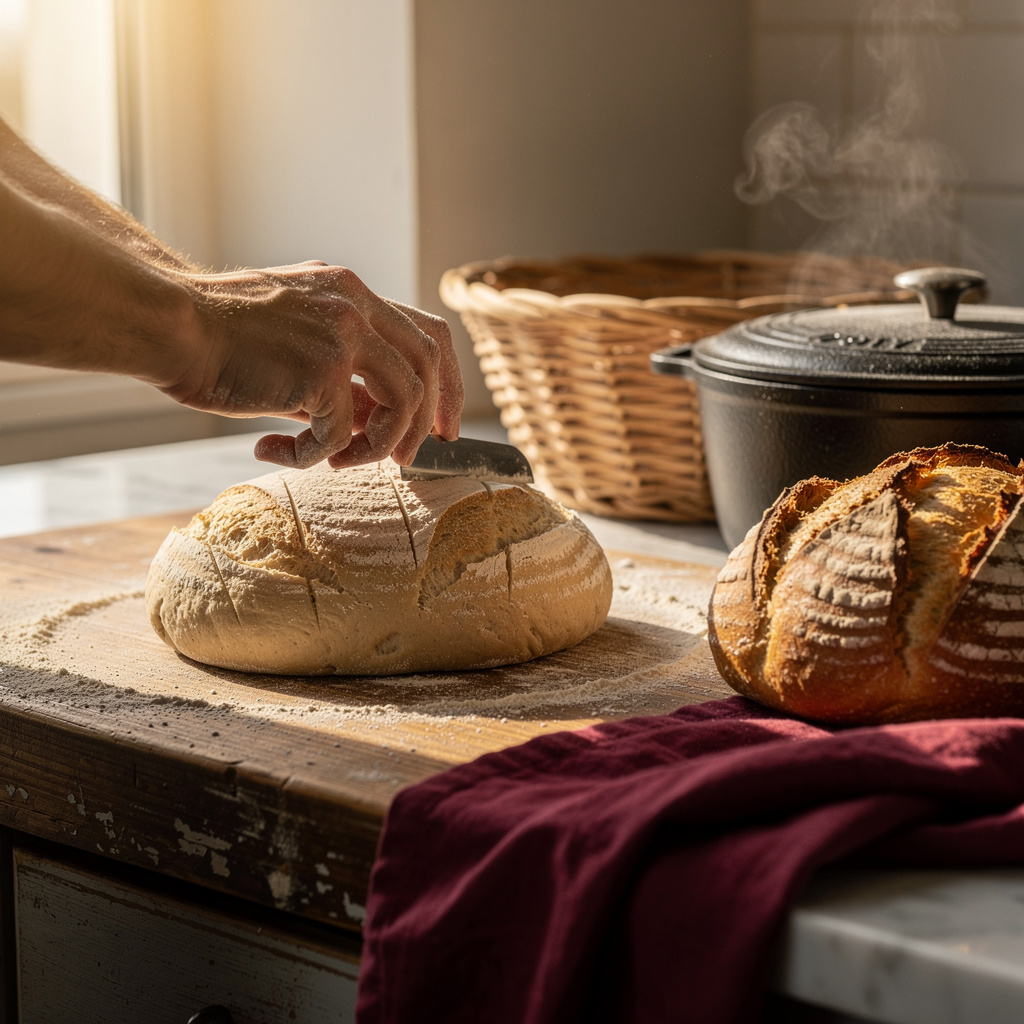
Sourdough bread baking is the craft and science of making naturally leavened bread with a live culture of wild yeasts and lactic acid bacteria rather than commercial baker’s yeast. Its scope runs from flour and water selection through starter maintenance, fermentation management, gluten development, dough shaping, and oven baking, ending with sensory evaluation of the finished loaf. Core concepts include microbial ecology, acidity and flavor development, hydration, temperature control, dough strength, gas retention, and heat transfer during baking. It is both a technical process and a sensory craft, because bakers must interpret sight, touch, smell, time, and taste alongside measurable variables.
Sourdough matters today because it connects home baking, artisan bakery production, food science, and fermentation research in a single practical discipline. In real life, it supports local grain economies, small bakery businesses, cottage-food enterprises, and home kitchens seeking flavorful bread with a long shelf life. In industry and academia, sourdough fermentation is studied for microbial stability, flavor chemistry, digestibility, and whole-grain utilization, while bakers use cold retardation and controlled routines to make production more predictable. Recent shifts toward whole grains, reproducible small-batch workflows, and online knowledge-sharing have made sourdough both more accessible and more process-driven than older myth-based approaches.
Mastering the subject builds a skill stack that combines biological literacy, process control, manual dough handling, sensory evaluation, systematic troubleshooting, and documentation of variables and outcomes. These skills transfer to bakery production, test-kitchen development, food writing and teaching, cottage-food operations, and serious home baking where consistency and adaptation matter. The bridge from subject knowledge to learner outcomes lies in understanding why dough behaves as it does, then using that understanding to diagnose faults, adjust formulas, and repeat successful bakes across flours, schedules, and environments. That combination of scientific reasoning and practiced hand skills benefits anyone who wants sourdough to be reliable rather than accidental.
What Will This Course Bring You?
- Select and organize sourdough ingredients, tools, and workspace conditions by matching flour types, hydration levels, and fermentation containers to a reliable baking workflow.
- Build a viable starter from scratch by applying measured feeding ratios, consistent temperatures, and visual and aromatic indicators of active wild-yeast fermentation.
- Revive and maintain a healthy starter by diagnosing sluggish rise, off aromas, or neglect and implementing scheduled refreshments that restore predictable leavening strength.
- Analyze microbial fermentation by explaining how wild yeast, lactic acid bacteria, temperature, hydration, and time shape dough rise, acidity, and flavor complexity.
- Apply gluten-development techniques by comparing mixing methods and fold schedules to build dough strength, extensibility, and gas retention for bulk fermentation.
- Shape and cold-proof dough by applying tension-building pre-shaping, final shaping, and banneton retardation techniques that produce a cohesive loaf ready for scoring.
- Score and bake sourdough by selecting blade angles, scoring patterns, oven temperature, and steam conditions that control loaf expansion, crust color, and oven spring.
- Troubleshoot and adapt recipes by evaluating crumb, crust, and flavor outcomes and adjusting hydration, starter strength, or fermentation time to improve repeatable whole-grain bakes.
Curriculum
12 Units1. Ingredients, Tools, and Workspace Setup
1 hour
2. Building a Starter from Scratch
1 hour
3. Maintaining and Reviving a Starter
1 hour
4. Fermentation Science and Microbial Activity
1 hour
5. Mixing and Gluten Development
1 hour
6. Bulk Fermentation and Folding
1 hour
7. Pre-Shaping and Shaping
1 hour
8. Final Proofing and Cold Retard
1 hour
9. Scoring and Oven Baking
1 hour
10. Evaluating Crumb, Crust, and Flavor
1 hour
11. Troubleshooting and Recipe Adaptation
1 hour
12. Whole-Grain Variations and Repeatable Routines
1 hour
Exam – Sourdough Bread Baking
20 Questions • 70% Pass • 30 min
Unlock All Units for Free
Create an account, enroll in the course, and start with the first unit right away.
Exam – Sourdough Bread Baking
20 Questions • Pass: 70% • 30 min
Course Duration
720
Total Minutes
12
Unit
1
Final Exam
~60
Min / Unit
Sourdough Bread Baking Certificate Program
Document Your Skill
Those who pass the 20-question, 30-minute exam with 70% receive the Sourdough Bread Baking Certificate.
Stand Out on Your CV
By adding your certificate to your CV, gain a professional reference in job applications and stand out from the crowd.
Career Advantage
With the verification code, employers can check your certificate instantly — a concrete way to show your growth.
CERTIFICATE FEE
At the end of the course, an online exam consisting of 20 questions with a 30-minute time limit is given. The exam appears automatically after you complete the topics. Anyone who scores at least 70 out of 100 on the certificate exam is awarded the Sourdough Bread Baking Document (certificate of attendance). You can add the certificate you earn to your CV for job applications in the many sectors listed above, and use it as a reference proving that you took this interactive course.
The Certificate of Achievement you receive with the Sourdough Bread Baking course program holds value that proves your personal and professional development in the business world. By adding it to your CV, it can serve as an important reference in your job applications. Moreover, compared with certificates from other private training institutions, Catch Wisdom certificates are offered to our participants at a much more affordable price.
The Sourdough Bread Baking course certificate is a document that proves, with a unique verification code, that you completed the course. Employers can instantly check its authenticity with this code, which helps you show your development concretely in your job applications.
For more information, we recommend visiting the Support page.
Certificate in 7 Languages
Earning success certificates from our courses is now more meaningful and global. With certificates available in Turkish, English, German, French, Spanish, Arabic, and Russian, we fully unlock the potential of students worldwide.
Why Certificate in 7 Languages?
-
01
Global Skill Development
Receiving your certificates in 7 different languages strengthens your communication skills as you engage with more people worldwide. It lets you operate more confidently and capably on the international stage.
-
02
International Job Opportunities
Employers may see your certificates in multiple languages as a sign of your ability to seize global opportunities. You can open more doors to new jobs and projects.
-
03
Cultural Richness
The chance to earn certificates in different languages helps you build closer ties with various cultures and broadens your worldview. It enriches your global perspective and deepens cultural understanding.
-
04
Ability to Participate in International Projects
Multilingual certificates give you an edge to work more effectively on international projects. They boost your chances of leadership and participation in diverse projects in the business world.
-
05
Prove Yourself on the Global Stage
Certificates in multiple languages give you the opportunity to present your skills and knowledge worldwide.
Language diversity opens worldwide opportunities. If you want to prove yourself in the international arena, join our online Sourdough Bread Baking course program and begin this journey with us.
Frequently Asked Questions (FAQ)
Is this course paid?
How do I join the course?
Can I take the course at my own pace?
How can I get my certificate?
What are the advantages of the certificate?
Boost Your Career
Take a new career step with the Sourdough Bread Baking course. Add your certificate to your CV, stand out in job applications, and open the door to new opportunities in the industry.
StartStudent Reviews
No reviews yet
Enroll in this course and be the first to leave a review about your experience with Sourdough Bread Baking.
Start