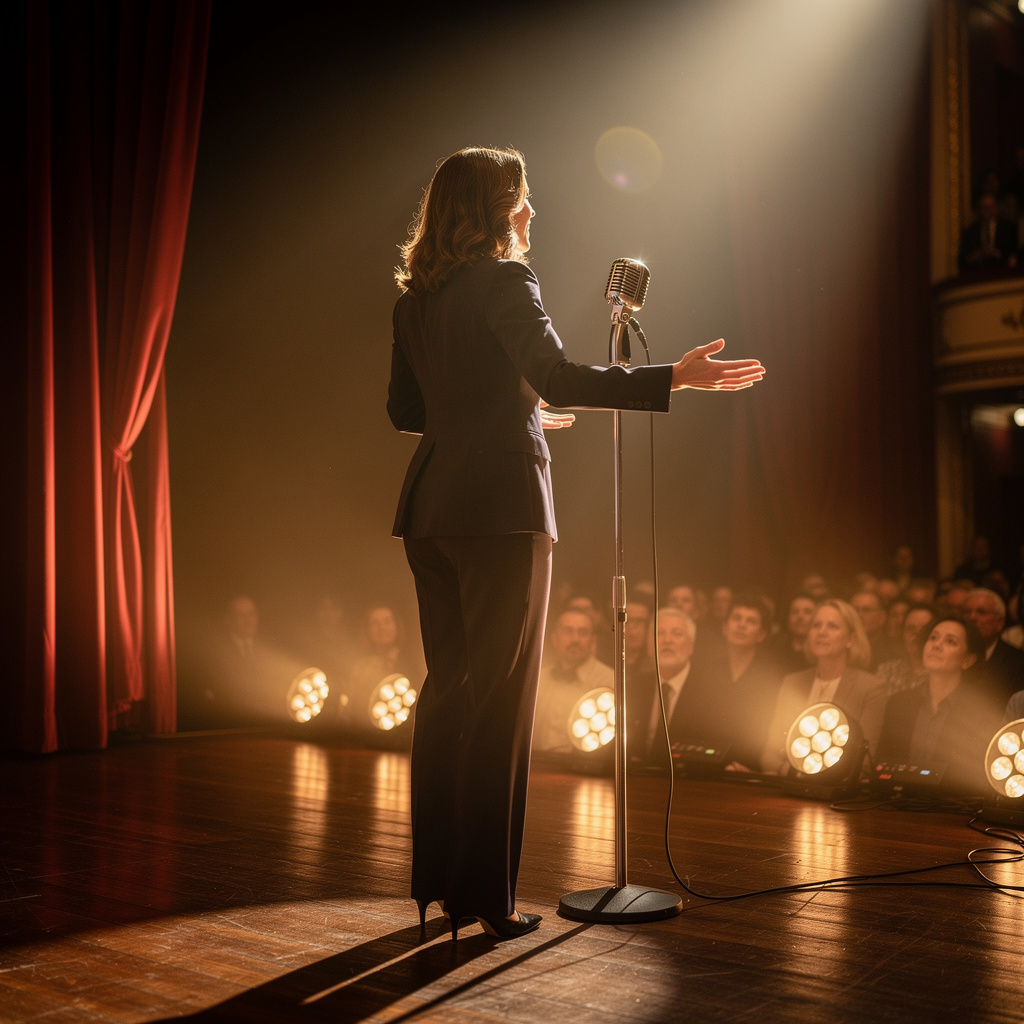
What is Stage Presence and Public Performance?
Stage Presence and Public Performance Training
Stage Presence and Public Performance certificate program equips participants with the physical, vocal, and psychological tools needed to command any stage or speaking platform with confidence. The curriculum covers foundational alignment and posture, breath support and projection, deliberate eye contact and facial expression, and the strategic use of gesture and space. It is designed for emerging performers, public speakers, educators, business professionals, and anyone who feels held back by nerves or a lack of polish in front of an audience. The main practical outcome is the ability to design and deliver a complete, authentic performance that holds attention and communicates clearly, whether on a theater stage, in a boardroom, or at a community event.
The program progresses in a beginner-friendly arc, starting with foundational body awareness and breath work before moving into expressive techniques like eye contact, gesture, and spatial dynamics. Each lesson balances concise theory with hands-on drills, so learners immediately apply concepts such as managing performance anxiety, timing, and silence in practical exercises. Across the twelve lessons, five core skill areas are built: physical presence, vocal command, expressive communication, psychological resilience, and audience engagement. The final lessons on improvisation, adapting to different venues, and rehearsal feedback culminate in designing and delivering a complete performance. Choosing this program now makes sense because live and hybrid communication demands authentic presence more than ever, and these skills transfer directly to leadership, teaching, sales, and creative work.
What is Stage Presence and Public Performance?
Stage presence and public performance refer to the integrated set of physical, vocal, and mental skills that allow a person to hold an audience's attention and communicate with impact in real time. Its scope includes body awareness, posture, and alignment; breath control, voice production, and projection; eye contact and facial expression; gesture, movement, and the intentional use of space. Core concepts also encompass managing performance anxiety, building audience connection, mastering timing, pacing, and silence, and improvising when the unexpected occurs. The field further extends to adapting one's delivery for different formats and venues, using rehearsal and feedback for continuous improvement, and ultimately designing a complete performance from start to finish. It is both an art and a craft, grounded in observable techniques that can be learned and refined.
In today's media-saturated world, stage presence matters far beyond traditional theater or concert stages. Professionals in business, education, politics, sales, and healthcare now present on camera, lead hybrid meetings, and speak at virtual or in-person events where audience attention is fragmented and easily lost. Recent shifts toward authenticity, vulnerability, and interactive engagement have made rigid, over-rehearsed delivery less effective than genuine, responsive presence. Social media and streaming platforms have also turned everyday communication into a form of public performance, raising the stakes for clear vocal projection, confident body language, and the ability to connect through a screen. As a result, universities, corporate training programs, and arts organizations increasingly treat stage presence as a core competency rather than a niche talent.
Mastering stage presence and public performance builds a transferable skill stack that includes somatic awareness, breath and voice control, emotional regulation under pressure, spatial intelligence, and real-time audience attunement. These capabilities support adaptive thinking, because performers must read a room and adjust pacing, gesture, or content on the fly. Reflective practices such as self-assessment and feedback integration further strengthen metacognition and continuous improvement. Professionals in leadership, teaching, sales, law, acting, music, and advocacy benefit from this skill stack, as do individuals seeking greater confidence in social or community settings. The subject ultimately empowers people to be fully present, expressive, and effective whenever they step into the spotlight, whether that spotlight is a stage, a camera, or a conference table.
Common Questions About Stage Presence and Public Performance
Is this Stage Presence and Public Performance course suitable for complete beginners?
How much live practice does the Stage Presence course include each week?
How does posture affect stage presence before I even start speaking?
Why is breath support more important than volume for vocal projection?
What eye contact cues do audiences actually read during a performance?
How do I use the nine-area grid to plan blocking on stage?
Is stage presence really something you are born with rather than built?
What Will This Course Bring You?
- Apply body awareness, posture, and alignment techniques to establish a grounded, open, and confident physical presence on stage.
- Implement breath support, vocal projection, and articulation exercises to deliver clear, resonant speech that reaches diverse audience sizes and venues.
- Design purposeful eye contact, facial expressions, and gestures that align with your message and strengthen audience connection during public performances.
- Evaluate personal anxiety triggers and apply grounding, reframing, and breath-control strategies to manage nerves before and during live performances.
- Analyze audience cues and adapt timing, pacing, pauses, and silence to sustain engagement and respond effectively to unexpected performance moments.
- Build improvisation skills by practicing spontaneous responses, flexible movement choices, and recovery techniques when performances deviate from planned material.
- Apply structured self-assessment and peer feedback protocols to refine rehearsal choices, strengthen performance consistency, and document specific improvements before final delivery.
- Create and deliver a complete performance that integrates stage presence, vocal variety, spatial movement, and audience engagement across at least two different venue formats.
Curriculum
12 Units1. Foundations of Stage Presence and Public Performance
1 hour
2. Body Awareness, Posture, and Alignment
1 hour
3. Breath, Voice, and Projection
1 hour
4. Eye Contact and Facial Expression
1 hour
5. Gesture, Movement, and Use of Space
1 hour
6. Managing Performance Anxiety and Nerves
1 hour
7. Audience Connection and Engagement
1 hour
8. Timing, Pacing, and Silence
1 hour
9. Improvisation and Handling the Unexpected
1 hour
10. Adapting to Different Performance Formats and Venues
1 hour
11. Rehearsal, Feedback, and Self-Assessment
1 hour
12. Designing and Delivering a Complete Performance
1 hour
Exam – Stage Presence and Public Performance
20 Questions • 70% Pass • 30 min
Unlock All Units for Free
Create an account, enroll in the course, and start with the first unit right away.
Exam – Stage Presence and Public Performance
20 Questions • Pass: 70% • 30 min
Course Duration
720
Total Minutes
12
Unit
1
Final Exam
~60
Min / Unit
Stage Presence and Public Performance Certificate Program
Document Your Skill
Those who pass the 20-question, 30-minute exam with 70% receive the Stage Presence and Public Performance Certificate.
Stand Out on Your CV
By adding your certificate to your CV, gain a professional reference in job applications and stand out from the crowd.
Career Advantage
With the verification code, employers can check your certificate instantly — a concrete way to show your growth.
CERTIFICATE FEE
At the end of the course, an online exam consisting of 20 questions with a 30-minute time limit is given. The exam appears automatically after you complete the topics. Anyone who scores at least 70 out of 100 on the certificate exam is awarded the Stage Presence and Public Performance Document (certificate of attendance). You can add the certificate you earn to your CV for job applications in the many sectors listed above, and use it as a reference proving that you took this interactive course.
The Certificate of Achievement you receive with the Stage Presence and Public Performance course program holds value that proves your personal and professional development in the business world. By adding it to your CV, it can serve as an important reference in your job applications. Moreover, compared with certificates from other private training institutions, Catch Wisdom certificates are offered to our participants at a much more affordable price.
The Stage Presence and Public Performance course certificate is a document that proves, with a unique verification code, that you completed the course. Employers can instantly check its authenticity with this code, which helps you show your development concretely in your job applications.
For more information, we recommend visiting the Support page.
Certificate in 7 Languages
Earning success certificates from our courses is now more meaningful and global. With certificates available in Turkish, English, German, French, Spanish, Arabic, and Russian, we fully unlock the potential of students worldwide.
Why Certificate in 7 Languages?
-
01
Global Skill Development
Receiving your certificates in 7 different languages strengthens your communication skills as you engage with more people worldwide. It lets you operate more confidently and capably on the international stage.
-
02
International Job Opportunities
Employers may see your certificates in multiple languages as a sign of your ability to seize global opportunities. You can open more doors to new jobs and projects.
-
03
Cultural Richness
The chance to earn certificates in different languages helps you build closer ties with various cultures and broadens your worldview. It enriches your global perspective and deepens cultural understanding.
-
04
Ability to Participate in International Projects
Multilingual certificates give you an edge to work more effectively on international projects. They boost your chances of leadership and participation in diverse projects in the business world.
-
05
Prove Yourself on the Global Stage
Certificates in multiple languages give you the opportunity to present your skills and knowledge worldwide.
Language diversity opens worldwide opportunities. If you want to prove yourself in the international arena, join our online Stage Presence and Public Performance course program and begin this journey with us.
Frequently Asked Questions (FAQ)
Is this course paid?
How do I join the course?
Can I take the course at my own pace?
How can I get my certificate?
What are the advantages of the certificate?
Boost Your Career
Take a new career step with the Stage Presence and Public Performance course. Add your certificate to your CV, stand out in job applications, and open the door to new opportunities in the industry.
StartStudent Reviews
No reviews yet
Enroll in this course and be the first to leave a review about your experience with Stage Presence and Public Performance.
Start