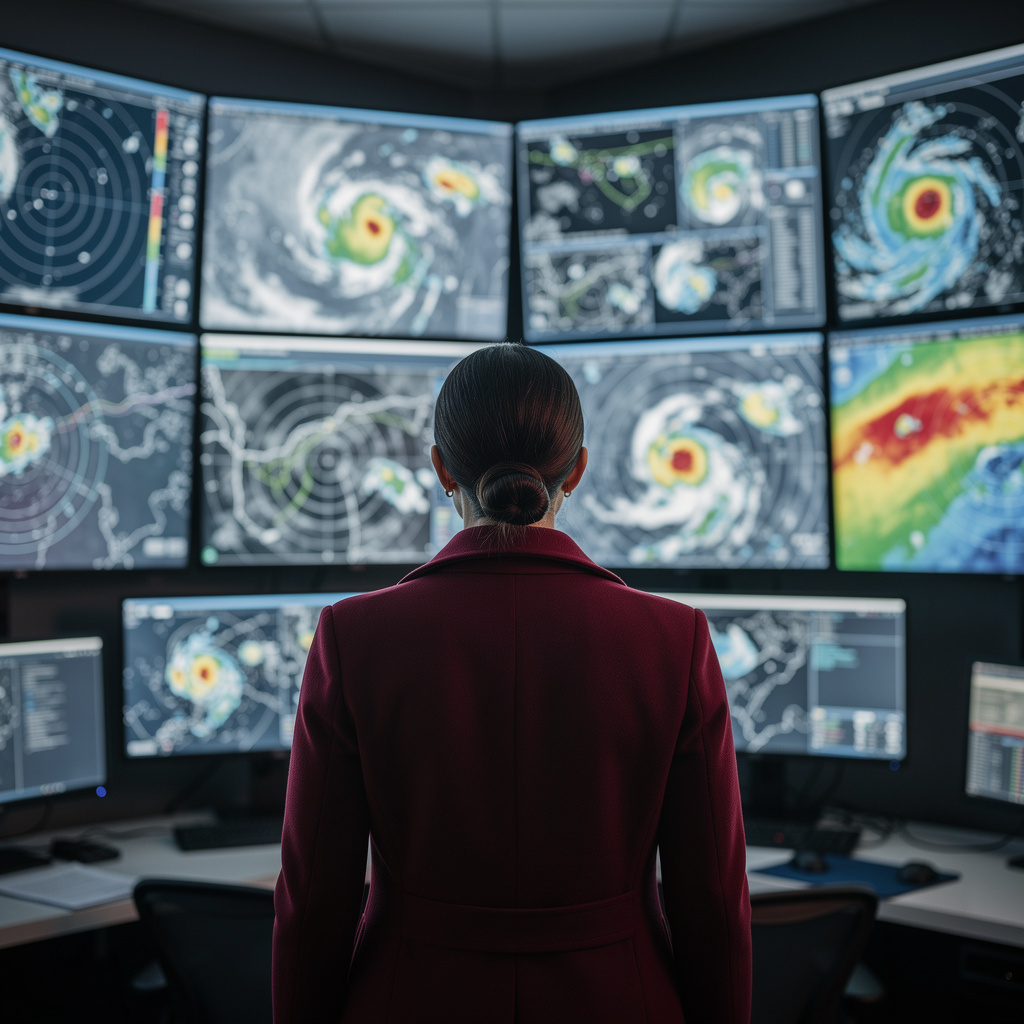
What is Weather and Forecasting Basics?
Weather and Forecasting Basics Certificate Program
The Weather and Forecasting Basics certificate program delivers a structured foundation in atmospheric science and everyday forecast interpretation for learners who want to understand why weather happens and how predictions are made. It teaches the core physical processes behind temperature, pressure, wind, humidity, clouds, precipitation, air masses, fronts, cyclones, thunderstorms, and tropical systems, then connects those concepts to real observational data and numerical forecast models. The program suits aspiring meteorologists, aviation and agriculture professionals, emergency management staff, outdoor industry workers, science educators, and weather enthusiasts who need practical meteorological literacy. Its main practical outcome is the ability to read weather observations and forecast products with confidence, recognize the atmospheric ingredients that drive significant weather, and make better-informed decisions based on forecast information.
The curriculum progresses in a beginner-friendly sequence, starting with Earth's atmosphere and heat transfer before moving into pressure and wind, humidity and dew point, cloud and precipitation processes, air masses and fronts, mid-latitude cyclones, severe thunderstorms, and tropical cyclones. Learners then work with weather observations and data sources, numerical weather prediction and forecast models, and finally the interpretation of operational forecasts, so theory is continuously tied to real-world map reading and forecast evaluation. The program builds five core skill areas: atmospheric thermodynamics, dynamical weather processes, synoptic and severe weather analysis, observational data literacy, and forecast model interpretation. It is a timely choice because increasing weather variability, high-impact severe events, and growing reliance on accurate forecasts across industries make foundational forecasting knowledge more valuable than ever.
What is Weather and Forecasting Basics?
Weather and Forecasting Basics is the study of the atmosphere's physical processes and the methods used to anticipate future atmospheric conditions. Its scope ranges from energy transfer and temperature patterns to pressure gradients, wind systems, moisture and phase changes, cloud formation, precipitation mechanisms, air mass boundaries, cyclonic systems, convective storms, and tropical cyclones. Core concepts include atmospheric stability, adiabatic processes, dew point and condensation, frontal analysis, synoptic-scale dynamics, and the interpretation of observational networks and numerical model output. The subject connects fundamental physics with the practical challenge of diagnosing current weather and projecting how it will evolve over hours to days.
This subject matters today because weather directly affects transportation, energy demand, agriculture, public safety, disaster preparedness, and outdoor operations, while also shaping insurance risk and supply chain planning. In industry, aviation, shipping, renewable energy, emergency management, and construction rely on forecast literacy to reduce exposure and optimize timing. In academia, atmospheric science and climate research depend on the same foundational concepts, and recent shifts toward higher-resolution models, ensemble forecasting, machine learning applications, and open weather data have made forecast interpretation more accessible and more data-rich. As extreme weather awareness grows, the ability to understand forecast uncertainty and communicate weather risk has become a widely relevant competency.
Mastering this subject builds a skill stack that combines physical reasoning, spatial map interpretation, data literacy, model awareness, and clear risk communication. These skills support professional contexts such as operational meteorology, aviation weather briefing, agricultural planning, emergency response coordination, outdoor recreation management, science journalism, and classroom teaching. Personal contexts also benefit, from travel and event planning to severe weather preparedness and informed public decision-making. The subject ultimately bridges atmospheric theory and everyday practice, giving learners a durable framework for making sense of forecasts rather than simply consuming them.
What Will This Course Bring You?
- Analyze how solar heating, atmospheric composition, and the greenhouse effect shape the vertical structure and general circulation of Earth's atmosphere.
- Apply the principles of conduction, convection, and radiation to explain temperature variations and heat transfer in the lower atmosphere.
- Interpret surface and upper-air pressure patterns to predict local wind direction and speed using pressure-gradient, Coriolis, and friction effects.
- Calculate relative humidity and dew point from temperature and moisture data, then assess condensation and cloud-formation potential in a given air parcel.
- Differentiate air masses and frontal types by analyzing temperature, humidity, and pressure changes to forecast associated weather transitions.
- Evaluate the development and track of mid-latitude cyclones using upper-level flow, jet streaks, and surface frontogenesis to anticipate precipitation and temperature shifts.
- Analyze thunderstorm and tropical cyclone environments using instability, wind shear, and moisture indicators to identify severe weather and coastal hazards.
- Interpret weather observations, model output, and forecast products to construct a short-term local forecast with stated uncertainty.
Curriculum
12 Units1. Earth's Atmosphere and Weather Fundamentals
1 hour
2. Temperature and Heat Transfer
1 hour
3. Atmospheric Pressure and Wind
1 hour
4. Humidity, Condensation, and Dew Point
1 hour
5. Clouds and Precipitation
1 hour
6. Air Masses and Fronts
1 hour
7. Mid-Latitude Cyclones and Weather Systems
1 hour
8. Thunderstorms and Severe Weather
1 hour
9. Tropical Cyclones and Coastal Weather
1 hour
10. Weather Observations and Data Sources
1 hour
11. Numerical Weather Prediction and Forecast Models
1 hour
12. Reading and Interpreting Weather Forecasts
1 hour
Exam – Weather and Forecasting Basics
20 Questions • 70% Pass • 30 min
Unlock All Units for Free
Create an account, enroll in the course, and start with the first unit right away.
Exam – Weather and Forecasting Basics
20 Questions • Pass: 70% • 30 min
Course Duration
720
Total Minutes
12
Unit
1
Final Exam
~60
Min / Unit
Weather and Forecasting Basics Certificate Program
Document Your Skill
Those who pass the 20-question, 30-minute exam with 70% receive the Weather and Forecasting Basics Certificate.
Stand Out on Your CV
By adding your certificate to your CV, gain a professional reference in job applications and stand out from the crowd.
Career Advantage
With the verification code, employers can check your certificate instantly — a concrete way to show your growth.
CERTIFICATE FEE
At the end of the course, an online exam consisting of 20 questions with a 30-minute time limit is given. The exam appears automatically after you complete the topics. Anyone who scores at least 70 out of 100 on the certificate exam is awarded the Weather and Forecasting Basics Document (certificate of attendance). You can add the certificate you earn to your CV for job applications in the many sectors listed above, and use it as a reference proving that you took this interactive course.
The Certificate of Achievement you receive with the Weather and Forecasting Basics course program holds value that proves your personal and professional development in the business world. By adding it to your CV, it can serve as an important reference in your job applications. Moreover, compared with certificates from other private training institutions, Catch Wisdom certificates are offered to our participants at a much more affordable price.
The Weather and Forecasting Basics course certificate is a document that proves, with a unique verification code, that you completed the course. Employers can instantly check its authenticity with this code, which helps you show your development concretely in your job applications.
For more information, we recommend visiting the Support page.
Certificate in 7 Languages
Earning success certificates from our courses is now more meaningful and global. With certificates available in Turkish, English, German, French, Spanish, Arabic, and Russian, we fully unlock the potential of students worldwide.
Why Certificate in 7 Languages?
-
01
Global Skill Development
Receiving your certificates in 7 different languages strengthens your communication skills as you engage with more people worldwide. It lets you operate more confidently and capably on the international stage.
-
02
International Job Opportunities
Employers may see your certificates in multiple languages as a sign of your ability to seize global opportunities. You can open more doors to new jobs and projects.
-
03
Cultural Richness
The chance to earn certificates in different languages helps you build closer ties with various cultures and broadens your worldview. It enriches your global perspective and deepens cultural understanding.
-
04
Ability to Participate in International Projects
Multilingual certificates give you an edge to work more effectively on international projects. They boost your chances of leadership and participation in diverse projects in the business world.
-
05
Prove Yourself on the Global Stage
Certificates in multiple languages give you the opportunity to present your skills and knowledge worldwide.
Language diversity opens worldwide opportunities. If you want to prove yourself in the international arena, join our online Weather and Forecasting Basics course program and begin this journey with us.
Frequently Asked Questions (FAQ)
Is this course paid?
How do I join the course?
Can I take the course at my own pace?
How can I get my certificate?
What are the advantages of the certificate?
Boost Your Career
Take a new career step with the Weather and Forecasting Basics course. Add your certificate to your CV, stand out in job applications, and open the door to new opportunities in the industry.
StartStudent Reviews
No reviews yet
Enroll in this course and be the first to leave a review about your experience with Weather and Forecasting Basics.
Start