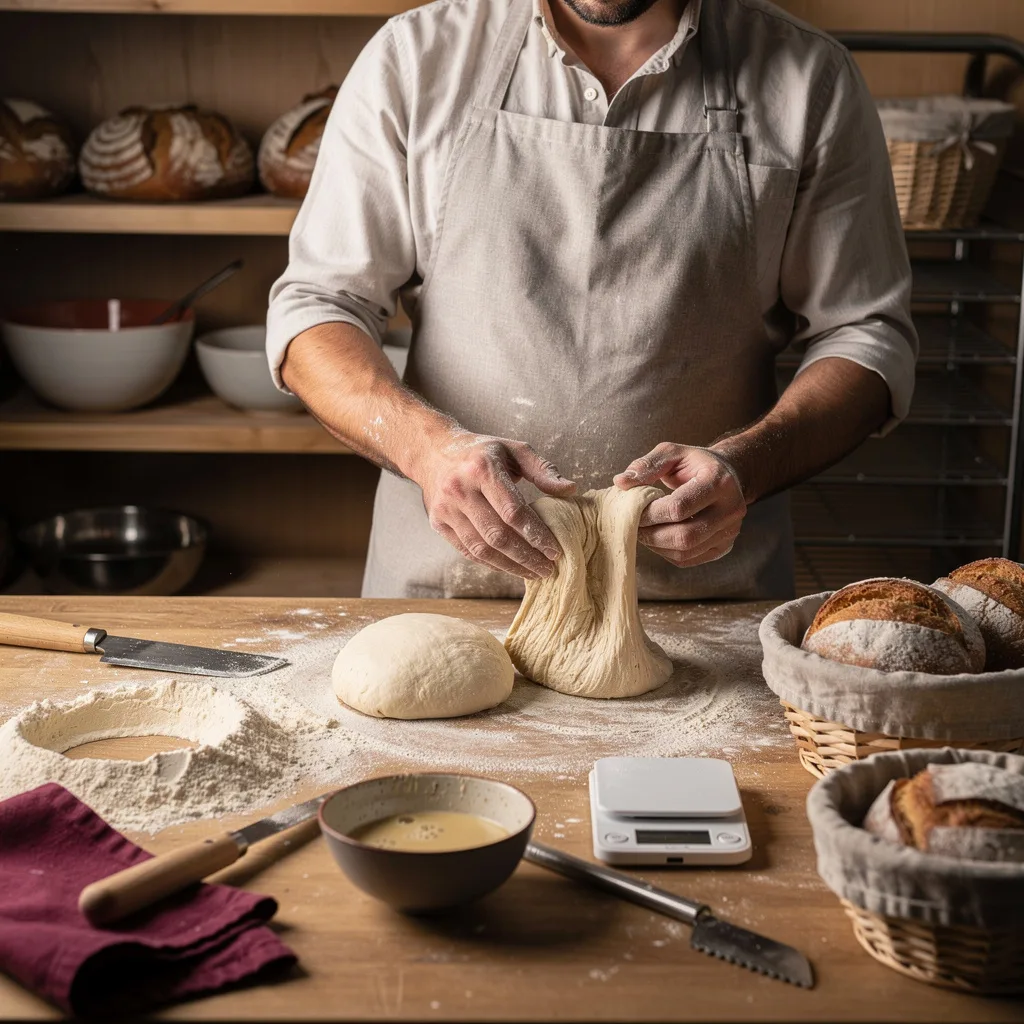
What is Sourdough Baking?
Sourdough Baking Training and Education Program
Sourdough Baking certificate program is a focused training path for home bakers, culinary students, and food entrepreneurs who want to understand naturally leavened bread from starter to finished loaf. The curriculum teaches flour selection and ingredient function, starter creation and maintenance, fermentation science, mixing and autolyse, bulk fermentation and folding, shaping and proofing, and controlled baking. Learners also practice evaluating crumb and crust, troubleshooting common faults, working with whole grains and specialty flours, and extending their skills into enriched and creative sourdough bakes. The main practical outcome is the ability to produce consistent, well-fermented sourdough bread and to diagnose and adjust a bake rather than rely on fixed recipes.
The program is structured as a beginner-friendly progression: it begins with the fundamentals of sourdough and ingredients, builds confidence through starter management and fermentation principles, then moves into hands-on mixing, folding, shaping, proofing, and baking. Theory and practice are balanced so that each technique is connected to the biological and chemical reasons behind it, including fermentation activity, gluten development, and dough temperature. Across the lessons, learners develop four core skill areas: ingredient and starter literacy, fermentation control, dough handling and shaping, and bake evaluation and troubleshooting. This program is a strong choice now because sourdough knowledge supports better bread quality, reduces reliance on commercial yeast, and gives bakers a durable skill set for home baking, small-scale production, and further culinary study.
What is Sourdough Baking?
Sourdough baking is the craft of making bread through the action of a live culture of wild yeast and lactic acid bacteria, rather than through commercial baker’s yeast alone. Its scope covers flour and water management, starter maintenance, fermentation control, dough development, shaping, proofing, and baking, with core concepts such as hydration, gluten structure, acidity, temperature, and time. The subject also includes evaluating the finished loaf through crust, crumb, flavor, and keeping quality, because sourdough is judged by both process and result. It extends beyond basic bread into whole-grain and specialty-flour baking, enriched doughs, and creative variations that test a baker’s understanding of fermentation and structure.
Sourdough baking matters today because it sits at the intersection of craft, food science, and small-scale food production. Bakeries, restaurants, and home bakers use sourdough to improve flavor, texture, and shelf life while responding to demand for naturally leavened and artisanal breads. Recent shifts toward local grains, whole-grain baking, and transparent production have made fermentation knowledge more valuable, and food science research continues to clarify how microbial communities and process variables affect bread quality. In academic and professional settings, sourdough is also a practical entry point for studying microbiology, dough rheology, and sustainable food systems.
Mastering sourdough baking builds a skill stack that combines observation, process control, and material judgment: reading fermentation cues, managing time and temperature, developing dough strength, and adjusting formulas based on flour behavior. These skills transfer to professional bakery production, recipe development, food writing, teaching, and small food business operations, where consistency and troubleshooting matter as much as creativity. On a personal level, the subject supports reliable home baking, resourceful use of whole grains, and a deeper understanding of how ingredients and microbes interact. The value lies less in memorizing one method than in developing the judgment to adapt a bake to changing conditions and ingredients.
What Will This Course Bring You?
- Build and maintain a healthy sourdough starter by applying feeding ratios, hydration adjustments, and contamination-prevention practices.
- Analyze flour composition and ingredient interactions to select appropriate flours and hydration levels for specific sourdough bread styles.
- Explain the fermentation science behind starter activity, dough rise, and flavor development to diagnose common sourdough fermentation issues.
- Implement mixing and autolyse techniques that develop gluten structure while preserving dough extensibility for subsequent bulk fermentation.
- Apply bulk fermentation and folding schedules to strengthen dough and achieve target dough temperature, volume, and structure.
- Shape and proof sourdough loaves using tension-building methods and proofing indicators to produce consistent oven spring.
- Bake sourdough loaves using scoring, steam, and oven management, then evaluate crust, crumb, and flavor to troubleshoot future bakes.
- Design advanced sourdough variations, including whole-grain blends and enriched doughs, by adjusting hydration, fermentation, and enrichment ratios.
Curriculum
12 Units1. Introduction to Sourdough Baking
1 hour
2. Understanding Flour and Ingredients
1 hour
3. Creating and Maintaining a Sourdough Starter
1 hour
4. The Science of Fermentation
1 hour
5. Mixing and Autolyse
1 hour
6. Bulk Fermentation and Folding
1 hour
7. Shaping and Proofing
1 hour
8. Baking Sourdough Bread
1 hour
9. Evaluating and Troubleshooting Your Bread
1 hour
10. Working with Whole Grains and Specialty Flours
1 hour
11. Enriched Sourdough and Sweet Bakes
1 hour
12. Advanced Techniques and Creative Variations
1 hour
Exam – Sourdough Baking
20 Questions • 70% Pass • 30 min
Unlock All Units for Free
Create an account, enroll in the course, and start with the first unit right away.
Exam – Sourdough Baking
20 Questions • Pass: 70% • 30 min
Course Duration
720
Total Minutes
12
Unit
1
Final Exam
~60
Min / Unit
Sourdough Baking Certificate Program
Document Your Skill
Those who pass the 20-question, 30-minute exam with 70% receive the Sourdough Baking Certificate.
Stand Out on Your CV
By adding your certificate to your CV, gain a professional reference in job applications and stand out from the crowd.
Career Advantage
With the verification code, employers can check your certificate instantly — a concrete way to show your growth.
CERTIFICATE FEE
At the end of the course, an online exam consisting of 20 questions with a 30-minute time limit is given. The exam appears automatically after you complete the topics. Anyone who scores at least 70 out of 100 on the certificate exam is awarded the Sourdough Baking Document (certificate of attendance). You can add the certificate you earn to your CV for job applications in the many sectors listed above, and use it as a reference proving that you took this interactive course.
The Certificate of Achievement you receive with the Sourdough Baking course program holds value that proves your personal and professional development in the business world. By adding it to your CV, it can serve as an important reference in your job applications. Moreover, compared with certificates from other private training institutions, Catch Wisdom certificates are offered to our participants at a much more affordable price.
The Sourdough Baking course certificate is a document that proves, with a unique verification code, that you completed the course. Employers can instantly check its authenticity with this code, which helps you show your development concretely in your job applications.
For more information, we recommend visiting the Support page.
Certificate in 7 Languages
Earning success certificates from our courses is now more meaningful and global. With certificates available in Turkish, English, German, French, Spanish, Arabic, and Russian, we fully unlock the potential of students worldwide.
Why Certificate in 7 Languages?
-
01
Global Skill Development
Receiving your certificates in 7 different languages strengthens your communication skills as you engage with more people worldwide. It lets you operate more confidently and capably on the international stage.
-
02
International Job Opportunities
Employers may see your certificates in multiple languages as a sign of your ability to seize global opportunities. You can open more doors to new jobs and projects.
-
03
Cultural Richness
The chance to earn certificates in different languages helps you build closer ties with various cultures and broadens your worldview. It enriches your global perspective and deepens cultural understanding.
-
04
Ability to Participate in International Projects
Multilingual certificates give you an edge to work more effectively on international projects. They boost your chances of leadership and participation in diverse projects in the business world.
-
05
Prove Yourself on the Global Stage
Certificates in multiple languages give you the opportunity to present your skills and knowledge worldwide.
Language diversity opens worldwide opportunities. If you want to prove yourself in the international arena, join our online Sourdough Baking course program and begin this journey with us.
Frequently Asked Questions (FAQ)
Is this course paid?
How do I join the course?
Can I take the course at my own pace?
How can I get my certificate?
What are the advantages of the certificate?
Boost Your Career
Take a new career step with the Sourdough Baking course. Add your certificate to your CV, stand out in job applications, and open the door to new opportunities in the industry.
StartStudent Reviews
No reviews yet
Enroll in this course and be the first to leave a review about your experience with Sourdough Baking.
Start