What is Violin Fundamentals?
Violin Fundamentals Training Program
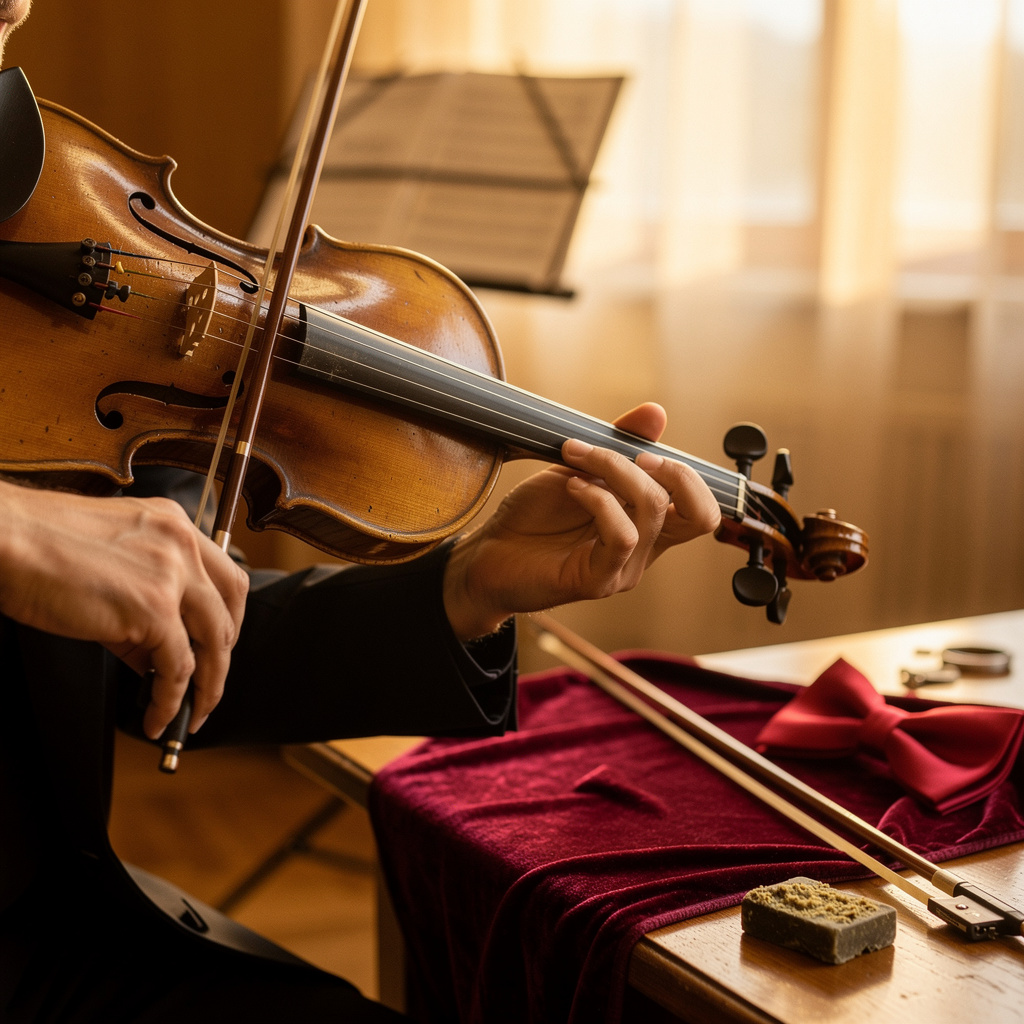
The Violin Fundamentals certificate program is a structured introduction to playing the violin, built for absolute beginners and returning players who want a dependable technical foundation rather than scattered tips. It moves through instrument setup and posture, open strings and basic bowing, left-hand placement and first fingers, and reading music notation, so physical technique and musical literacy develop side by side from the first session. Learners then apply these skills to one-octave scales and key signatures, first melodies with bowing patterns, and focused intonation and ear training. The central practical outcome is the ability to play simple repertoire with a steady tone, accurate pitch, and deliberate bow control instead of merely imitating a recording.
The program is arranged as a progressive sequence in which each lesson unlocks the next: posture and setup make bowing possible, bowing makes scales and melodies possible, and secure scales make shifting and vibrato reachable. Roughly half the work is hands-on playing and half is musicianship — notation reading, ear training, and practice strategy — so technique is never separated from musical understanding. Across the twelve lessons, five core skill areas are developed: posture and instrument handling, bowing and tone production, left-hand placement and intonation, music literacy and aural awareness, and expressive performance. Learners choose this program now because it consolidates the fragmented advice of tutorials and method books into one coherent path, and because it closes with practice strategies, repertoire building, and ensemble guidance so momentum continues after the final lesson.
What is Violin Fundamentals?
Violin fundamentals is the body of foundational technique and musicianship that underlies all violin playing, spanning the physical relationship between player and instrument as well as the mental map of pitch, rhythm, and phrasing. Its scope includes stance and instrument hold, bow grip and bow distribution, contact point and tone production, left-hand frame and finger placement, intonation, shifting, vibrato, dynamics, articulation, and the reading of notation and key signatures. Core concepts include the straight bow, the use of arm weight rather than muscular pressure, the link between finger spacing and key, and the ear's role in correcting pitch in real time. These elements are interdependent — a change in posture alters bowing, and a change in bowing alters tone — so fundamentals are best understood as a connected system rather than a set of isolated tricks.
Fundamentals matter today because the violin remains central to orchestras, chamber music, folk traditions, film and game scoring, and contemporary popular production, where string lines are sampled, layered, and recorded remotely. In academia, conservatories and music education programs treat foundational technique as the gatekeeper to advanced repertoire, and audition panels still evaluate candidates on tone, intonation, and bow control before anything else. Recent shifts have made this knowledge both more accessible and more demanding: online lessons and practice tools offer instant feedback, while the sheer volume of unfiltered advice makes a clear technical framework more valuable than ever. Teachers, arrangers, and producers also benefit from understanding fundamentals, since they must write and direct string parts that are physically playable.
Mastering violin fundamentals builds a transferable skill stack: fine motor control, sustained attention, pitch discrimination, rhythmic precision, reading fluency, and the discipline of deliberate practice. These abilities compound, because accurate intonation depends on trained hearing and expressive phrasing depends on reliable bow technique, so progress in one area reinforces the others. The resulting competence serves learners across many contexts — orchestral and ensemble playing, solo performance, teaching beginners, session recording, composing for strings, or simply playing with confidence at home. Because the fundamentals remain the same whether the goal is a first scale or a concerto, time invested here continues to pay off at every later stage of playing.
What Will This Course Bring You?
- Demonstrate proper violin setup and balanced posture by adjusting shoulder rest, chin rest, and bow hold before playing open strings.
- Apply basic bowing techniques to produce clear, steady tones on all four open strings using correct bow speed, contact point, and arm weight.
- Build accurate left-hand placement by positioning the first, second, third, and fourth fingers on the fingerboard to play stopped notes in first position.
- Interpret standard music notation by identifying notes, rhythms, key signatures, and bowing symbols in one-octave scales and first melodies.
- Evaluate personal intonation during one-octave scales and simple melodies by comparing played pitches with a drone or tuner and adjusting finger placement.
- Implement foundational shifting technique to move the left hand smoothly between first and third positions while maintaining consistent tone and posture.
- Develop initial vibrato motion by using relaxed arm, wrist, and finger movements to enrich sustained notes without disrupting pitch or bow control.
- Apply dynamic contrasts, articulation, and expressive phrasing in solo and ensemble performance while using structured practice strategies to build repertoire.
Curriculum
12 Units1. Instrument Setup and Posture
1 hour
2. Open Strings and Basic Bowing
1 hour
3. Left-Hand Placement and First Fingers
1 hour
4. Reading Music Notation
1 hour
5. One-Octave Scales and Key Signatures
1 hour
6. First Melodies and Bowing Patterns
1 hour
7. Intonation and Ear Training
1 hour
8. Introduction to Shifting and Third Position
1 hour
9. Vibrato Foundations
1 hour
10. Dynamics, Articulation, and Expression
1 hour
11. Practice Strategies and Repertoire Building
1 hour
12. Performance, Ensemble, and Next Steps
1 hour
Exam – Violin Fundamentals
20 Questions • 70% Pass • 30 min
Unlock All Units for Free
Create an account, enroll in the course, and start with the first unit right away.
Exam – Violin Fundamentals
20 Questions • Pass: 70% • 30 min
Course Duration
720
Total Minutes
12
Unit
1
Final Exam
~60
Min / Unit
Violin Fundamentals Certificate Program
Document Your Skill
Those who pass the 20-question, 30-minute exam with 70% receive the Violin Fundamentals Certificate.
Stand Out on Your CV
By adding your certificate to your CV, gain a professional reference in job applications and stand out from the crowd.
Career Advantage
Catch Wisdom certificates are recognized by HR departments and increase career opportunities.
CERTIFICATE FEE
At the end of the course, an online exam consisting of 20 questions with a 30-minute time limit is given. The exam appears automatically after you complete the topics. Anyone who scores at least 70 out of 100 on the certificate exam is awarded the Violin Fundamentals Document (certificate of attendance). You can add the certificate you earn to your CV for job applications in the many sectors listed above, and use it as a reference proving that you took this interactive course.
The Certificate of Achievement you receive with the Violin Fundamentals course program holds value that proves your personal and professional development in the business world. By adding it to your CV, it can serve as an important reference in your job applications. Moreover, compared with certificates from other private training institutions, Catch Wisdom certificates are offered to our participants at a much more affordable price.
Because HR departments recognize Catch Wisdom as a reputable institution in this field, they value these certificates and may evaluate your job applications favorably. For this reason, a Violin Fundamentals course certificate from Catch Wisdom can make your applications more attractive and place you in an advantageous position in the business world.
For more information, we recommend visiting the Support page.
Certificate in 7 Languages
Earning success certificates from our courses is now more meaningful and global. With certificates available in Turkish, English, German, French, Spanish, Arabic, and Russian, we fully unlock the potential of students worldwide.
Why Certificate in 7 Languages?
-
01
Global Skill Development
Receiving your certificates in 7 different languages strengthens your communication skills as you engage with more people worldwide. It lets you operate more confidently and capably on the international stage.
-
02
International Job Opportunities
Employers may see your certificates in multiple languages as a sign of your ability to seize global opportunities. You can open more doors to new jobs and projects.
-
03
Cultural Richness
The chance to earn certificates in different languages helps you build closer ties with various cultures and broadens your worldview. It enriches your global perspective and deepens cultural understanding.
-
04
Ability to Participate in International Projects
Multilingual certificates give you an edge to work more effectively on international projects. They boost your chances of leadership and participation in diverse projects in the business world.
-
05
Prove Yourself on the Global Stage
Certificates in multiple languages let you showcase your skills and knowledge worldwide. You can become an internationally recognized professional.
Language diversity opens worldwide opportunities. If you want to prove yourself in the international arena, join our online Violin Fundamentals course program and begin this journey with us.
Frequently Asked Questions (FAQ)
Is this course paid?
How do I join the course?
Can I take the course at my own pace?
How can I get my certificate?
What are the advantages of the Certified Certificate?
Boost Your Career
Take a new career step with the Violin Fundamentals course. Add your certificate to your CV, stand out in job applications, and open the door to new opportunities in the industry.
StartStudent Reviews
No reviews yet
Enroll in this course and be the first to leave a review about your experience with Violin Fundamentals.
Start