What is Urban Beekeeping?
Urban Beekeeping Certificate Program
Urban Beekeeping certificate program teaches the practical and regulatory foundations of keeping honey bee colonies in cities, from bee biology and colony structure in urban settings to hive installation, inspections, and record keeping. It is designed for aspiring urban beekeepers, community gardeners, educators, property managers, and sustainability-minded residents who want to support pollinators without creating avoidable conflicts with neighbors or municipal rules. Participants work through urban apiary site selection, hive types and equipment, seasonal spring and summer management, honey harvesting and processing, pest and disease management, swarm prevention, and winter preparation. The main practical outcome is the ability to plan, start, and maintain a productive urban hive responsibly, with compliance, neighbor relations, and colony health treated as core management skills rather than afterthoughts.
The program is structured as a beginner-friendly progression that moves from colony biology and urban regulations into site preparation, colony installation, routine inspections, and seasonal decision-making. Theory is balanced with practice-oriented planning, so learners connect inspection records, swarm control choices, and harvest timing to the real constraints of rooftops, backyards, balconies, and community gardens. Across the lessons, it builds five core skill areas: colony biology and hive management, regulatory and community literacy, seasonal and harvest operations, pest and disease response, and advanced colony multiplication with community engagement. Learners choose this program now because urban beekeeping demands more than enthusiasm; cities require beekeepers who can read colony signals, document decisions, communicate with neighbors, and adapt to changing local rules and forage conditions.
What is Urban Beekeeping?
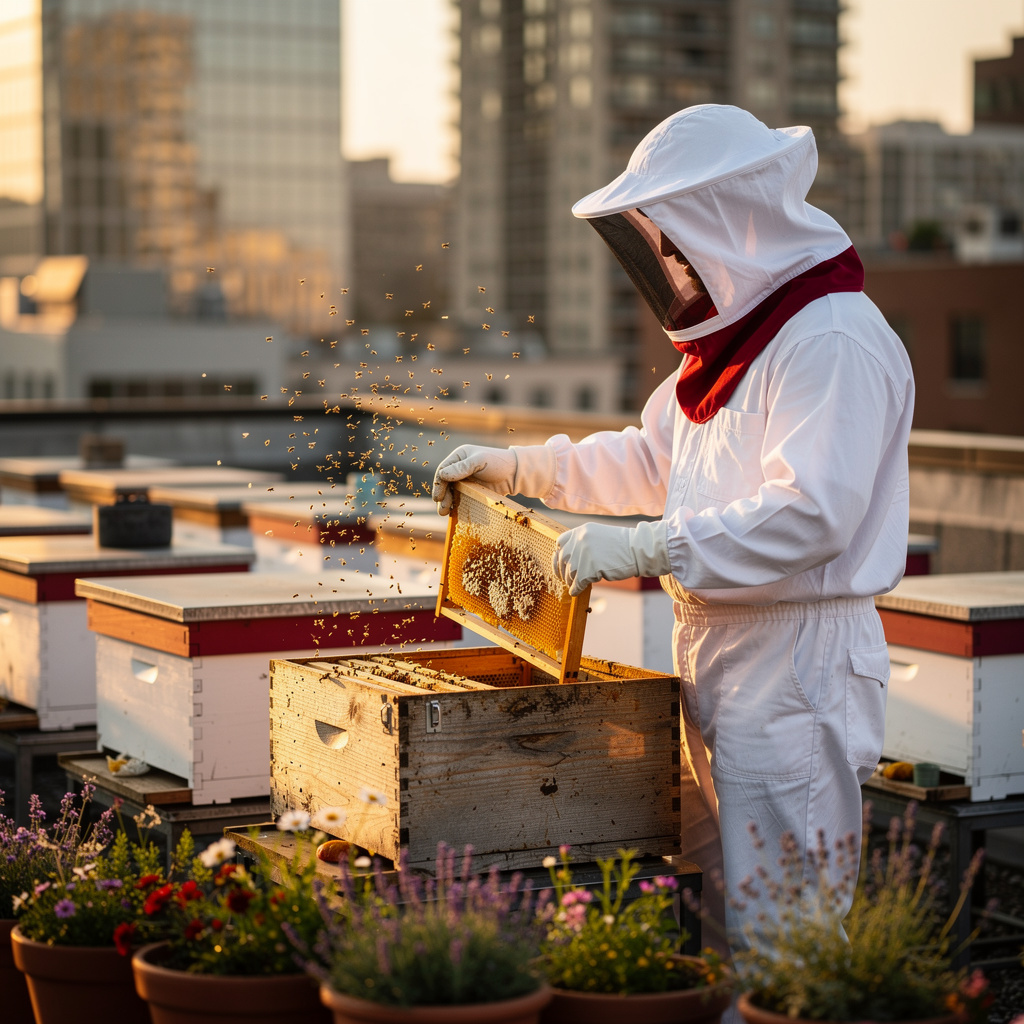
Urban beekeeping is the managed care of honey bee colonies within cities, towns, and densely populated landscapes, where forage, flight paths, hive placement, and human activity overlap. Its scope includes colony biology and social structure, apiary siting, hive equipment, seasonal management, honey production, pest and disease control, swarm prevention, and winter preparation in built environments. Core concepts include the colony as a superorganism, carrying capacity and forage availability, microclimate and wind exposure, biosecurity, record keeping, and the social contract between beekeepers, neighbors, and municipal authorities. Unlike rural beekeeping, urban practice must constantly balance bee health and productivity with space limits, public safety, property access, and community expectations.
Urban beekeeping matters today because cities are investing in pollinator habitat, urban agriculture, green roofs, and food resilience while confronting pollinator declines and habitat fragmentation. It appears in community gardens, school programs, rooftop apiaries, urban farms, municipal sustainability initiatives, and small local honey businesses, and it is increasingly studied in urban ecology and pollinator health research. Recent shifts include tighter municipal permitting, greater attention to native pollinator needs and responsible stocking density, stronger emphasis on disease monitoring, and consumer interest in hyperlocal, traceable honey. These changes make urban beekeeping a policy-aware and community-facing practice, not simply a backyard hobby.
Mastering urban beekeeping builds a skill stack that combines ecological observation, animal husbandry, regulatory literacy, risk communication, record keeping, integrated pest management, and hygienic harvest handling. It also develops community facilitation skills, because successful urban apiaries depend on explaining swarm plans, flight paths, and hive maintenance to neighbors, landlords, and local officials. These capabilities are useful in urban farms, community gardens, schools, property management, sustainability programs, food businesses, and personal stewardship projects where pollinator support must be practical and socially acceptable. The subject therefore bridges biological knowledge with civic and operational judgment, preparing people to make defensible decisions in shared urban spaces.
What Will This Course Bring You?
- Analyze honey bee biology and colony structure to predict how urban constraints such as limited forage and close neighbors affect hive behavior and management.
- Evaluate local regulations, permit requirements, and neighbor-relations strategies to design a compliant, community-friendly apiary plan for a specific city property.
- Design an urban apiary site and select hive equipment that addresses sunlight, wind, water, flight paths, security, space limits, cost, and inspection ease.
- Implement safe colony installation and routine inspection practices, using records to document queen status, colony health, resource stores, and early establishment in an urban hive.
- Apply seasonal spring and summer management techniques to build colony strength, manage space, and prepare urban hives for honey flow and swarm pressure.
- Evaluate honey harvesting, processing, and urban marketing options to produce safe, legally compliant products and communicate their value to local customers.
- Implement integrated urban pest, disease, and swarm management actions that protect colony health while reducing nuisance and chemical exposure risks to neighbors.
- Design winter preparation and advanced urban beekeeping plans, including queen rearing, nucleus colony management, and community engagement activities that strengthen local beekeeping capacity.
Curriculum
12 Units1. Bee Biology and Colony Structure for Urban Settings
1 hour
2. Urban Beekeeping Regulations, Permits, and Neighbor Relations
1 hour
3. Choosing and Preparing an Urban Apiary Site
1 hour
4. Hive Types and Equipment for Urban Beekeeping
1 hour
5. Installing and Starting a Colony in the City
1 hour
6. Routine Hive Inspections and Record Keeping
1 hour
7. Seasonal Colony Management: Spring and Summer
1 hour
8. Honey Harvesting, Processing, and Marketing in Urban Areas
1 hour
9. Urban Pest and Disease Management
1 hour
10. Swarm Prevention and Control in Urban Environments
1 hour
11. Preparing Colonies for Winter in the City
1 hour
12. Advanced Urban Beekeeping: Queen Rearing, Nucs, and Community Engagement
1 hour
Exam – Urban Beekeeping
20 Questions • 70% Pass • 30 min
Unlock All Units for Free
Create an account, enroll in the course, and start with the first unit right away.
Exam – Urban Beekeeping
20 Questions • Pass: 70% • 30 min
Course Duration
720
Total Minutes
12
Unit
1
Final Exam
~60
Min / Unit
Urban Beekeeping Certificate Program
Document Your Skill
Those who pass the 20-question, 30-minute exam with 70% receive the Urban Beekeeping Certificate.
Stand Out on Your CV
By adding your certificate to your CV, gain a professional reference in job applications and stand out from the crowd.
Career Advantage
With the verification code, employers can check your certificate instantly — a concrete way to show your growth.
CERTIFICATE FEE
At the end of the course, an online exam consisting of 20 questions with a 30-minute time limit is given. The exam appears automatically after you complete the topics. Anyone who scores at least 70 out of 100 on the certificate exam is awarded the Urban Beekeeping Document (certificate of attendance). You can add the certificate you earn to your CV for job applications in the many sectors listed above, and use it as a reference proving that you took this interactive course.
The Certificate of Achievement you receive with the Urban Beekeeping course program holds value that proves your personal and professional development in the business world. By adding it to your CV, it can serve as an important reference in your job applications. Moreover, compared with certificates from other private training institutions, Catch Wisdom certificates are offered to our participants at a much more affordable price.
The Urban Beekeeping course certificate is a document that proves, with a unique verification code, that you completed the course. Employers can instantly check its authenticity with this code, which helps you show your development concretely in your job applications.
For more information, we recommend visiting the Support page.
Certificate in 7 Languages
Earning success certificates from our courses is now more meaningful and global. With certificates available in Turkish, English, German, French, Spanish, Arabic, and Russian, we fully unlock the potential of students worldwide.
Why Certificate in 7 Languages?
-
01
Global Skill Development
Receiving your certificates in 7 different languages strengthens your communication skills as you engage with more people worldwide. It lets you operate more confidently and capably on the international stage.
-
02
International Job Opportunities
Employers may see your certificates in multiple languages as a sign of your ability to seize global opportunities. You can open more doors to new jobs and projects.
-
03
Cultural Richness
The chance to earn certificates in different languages helps you build closer ties with various cultures and broadens your worldview. It enriches your global perspective and deepens cultural understanding.
-
04
Ability to Participate in International Projects
Multilingual certificates give you an edge to work more effectively on international projects. They boost your chances of leadership and participation in diverse projects in the business world.
-
05
Prove Yourself on the Global Stage
Certificates in multiple languages give you the opportunity to present your skills and knowledge worldwide.
Language diversity opens worldwide opportunities. If you want to prove yourself in the international arena, join our online Urban Beekeeping course program and begin this journey with us.
Frequently Asked Questions (FAQ)
Is this course paid?
How do I join the course?
Can I take the course at my own pace?
How can I get my certificate?
What are the advantages of the certificate?
Boost Your Career
Take a new career step with the Urban Beekeeping course. Add your certificate to your CV, stand out in job applications, and open the door to new opportunities in the industry.
StartStudent Reviews
No reviews yet
Enroll in this course and be the first to leave a review about your experience with Urban Beekeeping.
Start